Executive summary. ACTO's March 2026 launch of AI workflow agents for its Intelligent Field Excellence platform marks a significant development in how regulated life sciences organizations approach intelligent automation. As AI agents transition from advisory tools to active workflow participants in training, certification, content governance, and field coaching, data integrity and AI governance become primary design constraints. This article examines ACTO's initiative within the context of pharmaceutical compliance, healthcare AI regulation, and emerging best practices for governing agentic systems in high-stakes environments.
A New Phase of Life Sciences Automation: ACTO AI Agents in Context
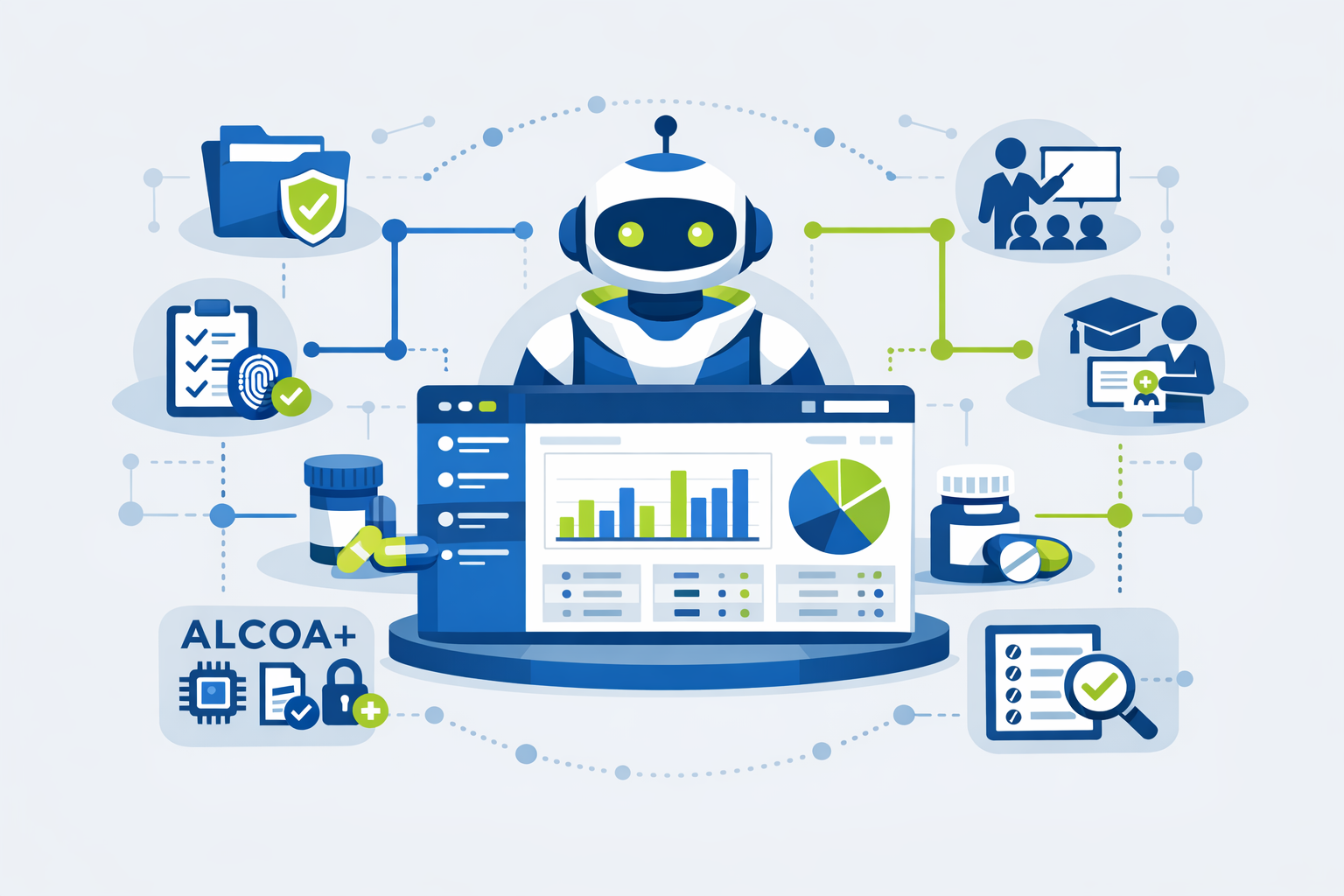
On March 18, 2026, ACTO announced "ACTO AI," a suite of 17 workflow agents designed to streamline training development, certification, content management, information retrieval, and insight generation within its field excellence platform for pharmaceutical, biotech, and medtech organizations[1]. These agents automate tasks such as creating learning programs, drafting coaching reports, and providing a conversational interface for dashboards and field data.
ACTO presents these AI agents as tools to "agentify" portions of commercial and medical workflows rather than supplant human decision-making. The company states that AI SuperAgents can assume up to 30% of the workload in customer-facing roles by automating repeatable, rules-based tasks[1]. This approach reflects broader healthcare AI trends where agentic systems operate in preparation, summarization, and monitoring, but leave clinical and strategic decisions to qualified professionals.[2]
From an enterprise software perspective, this represents a shift from static life sciences automation (LMS workflows, CRM triggers, rules engines) to adaptive agents that:
- Ingest and process multiple data sources (MRL-approved content, training records, field activity logs)
- Determine which tools to use (content generators, scoring logic, search connectors)
- Generate outputs integrated into GxP-relevant systems (certification records, coaching reports, content metadata)
This evolution heightens concerns regarding traceability, role boundaries, and auditability in pharma compliance and healthcare IT, while enabling deeper incorporation of data integrity and AI governance into field operations.
How AI workflow agents differ from traditional field automation
A comparative framework highlights key differences between conventional automation and agentic workflows such as ACTO AI:
| Dimension | Traditional field automation (CRM, LMS, rules) | AI workflow agents (e.g., ACTO AI) |
|---|---|---|
| Primary function | Trigger predefined workflows | Plan and execute multi-step tasks, dynamically selecting tools and content |
| Degree of autonomy | Low-moderate (rules, decision trees) | Moderate-high within guardrails; generate content and evaluations |
| Data inputs | Structured fields, static documents | Structured and unstructured data (content repositories, training records, dashboards, field notes) |
| Output types | Tasks, emails, status updates, simple forms | Draft coaching reports, learning programs, quiz questions, certification scores, narrative insights |
| Governance locus | Application configuration and SOPs | Cross-cutting AI governance: data provenance, model behavior, human-in-the-loop, lifecycle monitoring |
| Compliance exposure | Workflow correctness, access control | Data integrity of AI-touched records, explainability, validation of dynamic outputs |
The table underscores that once agents generate or modify records feeding into quality systems, those records require governance as GxP data, not as mere convenience artifacts.
Data Integrity and AI Governance in Healthcare and Pharma
Regulatory frameworks have expanded classical GxP data integrity expectations to encompass digital and AI-driven environments. Global data integrity frameworks in pharma and clinical systems are often summarized by ALCOA+, which requires regulated records to be Attributable, Legible, Contemporaneous, Original, Accurate, Complete, Consistent, Enduring, and Available[3].
Recent guidance extends ALCOA+ principles beyond laboratory and manufacturing data to AI artifacts-training datasets, prompts, model parameters, and outputs in GxP environments[4]. Thus, AI-generated coaching reports, certification decisions, and content governance actions may be subject to inspection.
The EU AI Act adds horizontal governance requirements for healthcare AI and AI in pharma. The Act classifies AI systems in healthcare and as medical software as "high-risk," requiring documented risk management, quality management systems, robust data governance, human oversight, transparency measures, and lifecycle logging[5]. These requirements integrate AI agents with sectoral rules (e.g., GxP, 21 CFR Part 11) and AI-specific obligations.
Data integrity lapses remain under regulatory scrutiny. White papers indicate continued enforcement focus on audit trail deficiencies and electronic record controls, increasing emphasis on robust, time-stamped logs across GMP, GLP, and GCP environments[6]. As AI tools proliferate in labs and commercial operations, inspection expectations now cover AI-touched records and decision pathways.[7]
Enterprise governance models-such as the NIST AI Risk Management Framework-recommend continuous, embedded AI governance.[8] This aligns with field excellence platforms, where always-on AI agents continually learn and thus require ongoing risk and compliance oversight.
Governance Lessons from ACTO's AI Agent Strategy
ACTO's materials on ACTO AI and "Compliant AI for Pharma & Med Device" highlight several governance design patterns relevant to regulated healthcare workflows.[1] Three themes stand out for senior IT and business leaders evaluating AI agents in these settings.
1. Align automation rules to regulation: explicit guardrails, audit trails, versioned workflows
ACTO positions its agents as operating "with humans in control," emphasizing automated handling of manual tasks in content governance and certification, with teams retaining approval authority.[1] Its guidance stresses "no-go zones"-constraints preventing agents from surfacing unapproved content or exceeding their roles.[9]
For pharma compliance and data integrity, this approach supports three control requirements:
Scope-bound autonomy
- Define, in controlled documents, allowable and prohibited agent tasks (e.g., drafting but not modifying approved claims).
- Employ technical guardrails to enforce boundaries in real time.
Interaction-level audit trails
- Log every decision path and tool interaction, producing granular records rather than basic error logs.[9]
- These records enable inspection teams to reconstruct certification decisions or content changes, meeting ALCOA+ standards for attribution and contemporaneity.
Versioned workflows and prompts
- Version-control changes to prompts, routing logic, or agent tools under the existing validated software change-control system.
- This practice extends computerized system validation (CSV) to AI, ensuring algorithmic changes are documented and assessed with each application update.[10]
CIOs and IT leaders should treat AI agents as semi-autonomous workflow participants whose logic and logs are accessible to governance functions, not as opaque software features.
2. Clarify ownership and maintain human-in-the-loop control
Governance involves both technical and organizational measures. ACTO's guidance reinforces that:
- AI systems must meet the same regulatory and ethical standards as human staff
- A named internal owner is required for each agent
- Agents must undergo a field-readiness certification process prior to deployment with healthcare professionals or external stakeholders[9]
These elements align with wider AI governance best practices:
- The EU AI Act requires ongoing human oversight for high-risk healthcare AI, enabling professionals to audit or override AI-supported decisions impacting patient care[5]
- Enterprise compliance guidance emphasizes human-in-the-loop review as essential for policy interpretation, regulatory monitoring, and exceptions[11]
Key implications include:
Role-specific accountability
- Assign product ownership for each significant agent (e.g., "Field Certification Agent Owner") and define autonomous versus approval-required decisions.
Operational human-in-the-loop patterns
- Employ agents to draft or pre-score outputs, but require human review for high-impact cases (e.g., certification, remedial coaching).
Lifecycle oversight
- Integrate agent performance, exceptions, and incidents into existing quality and pharmacovigilance governance mechanisms.
- Register agents as configuration items in the organization's AI risk register and quality system, consistent with NIST AI RMF and the EU AI Act.[8]
3. Prioritize data provenance, lineage, and source controls
ACTO identifies "source contamination"-agents accessing unvalidated or unapproved data-as a key risk.[9] Its approach includes:
- Restricting agents to validated, company-approved systems
- Ensuring traceability of outputs to MLR-approved or validated sources
Best practices reflected in industry guidance include:
Strict source whitelisting
- Integrate agents only with repositories and APIs covered by GxP or promotional compliance (e.g., Veeva Vault PromoMats, validated training libraries).[12]
- Avoid use of general web search or unvetted data in production agents supporting regulated workflows.
End-to-end lineage capture
- Treat training data, prompts, contextual references, and outputs as controlled records under ALCOA+, establishing traceable links.[4]
- For example, agent-generated decisions should connect to source video, scoring rubric version, and model configuration.
Data-quality monitoring for AI inputs
- The EU AI Act requires data governance for representativeness, relevance, and input data quality.[13]
- Regular monitoring for outdated content or shifting guidelines is essential, with prompt updates to knowledge bases and prompts.
Lacking these data controls, well-designed agents can inadvertently undermine compliance by distributing unapproved content at scale.
Implications for Healthcare IT and Pharma Operations Leaders
The ACTO launch reflects a wider trend: enterprise vendors incorporating agentic capabilities into platforms that serve regulated sectors. CIOs, CTOs, and enterprise architects should consider several implications.
Platform strategy and integration
Agent integration will become standard in core platforms
CRM, LMS, CLM, and field excellence platforms are embedding AI agents for content generation, insight summarization, and workflow orchestration, requiring a consistent risk-based enablement strategy.AI governance must cover both vendor and in-house systems
Organizations will manage:- Vendor-provided agents within SaaS platforms (e.g., field coaching, content governance)
- Internally developed agents running on general-purpose AI infrastructure Unified governance and risk frameworks are needed across both categories.
Risk posture and unapproved AI use
Recent surveys report that approximately 59% of employees use unapproved AI tools at work, often outside formal governance processes[14]. In life sciences, shadow AI use can undermine compliance and hinder audits.
Adopting governed agents in validated platforms can redirect users from unmanaged tools, but only if robust governance, logging, and data controls are in place and demonstrable to auditors.
Operating model and competencies
With AI agents expanding across life sciences automation, organizations need new capabilities across IT, Quality, Compliance, and Commercial Excellence:
- AI product ownership and lifecycle management
- AI-centric CSV and validation engineering
- Data governance spanning training data, prompts, and outputs
- Cross-functional AI risk committees involving medical, compliance, and pharmacovigilance leadership
Frameworks like the NIST AI RMF and EU AI Act encourage an ongoing, risk-aware approach rather than one-time certification.[8] Field excellence deployments present a clear setting to operationalize this model.
Actionable Steps for Governing AI Agents in Life Sciences Field Excellence
For organizations considering ACTO-like agents or comparable solutions, several practical steps align with emerging industry practice.
1. Catalog AI agent inventory and classify risks
- Inventory current and planned AI agents across commercial, medical, clinical, and supply chain use cases
- Classify by:
- Business domain (e.g., training, coaching)
- Impact on compliance records (GxP, promotional, safety)
- Autonomy level (advisory vs. operational)
- Risk category per internal/EU AI Act frameworks
2. Map ALCOA+ and GxP requirements to agent workflows
- Identify agent touchpoints with:
- LMS certifications
- PromoMats or similar promotional content repositories
- CRM logs, call notes
- Specify how each ALCOA+ dimension is addressed:
- Attribution for agent and human contributions
- Immutable, time-stamped audit trails
- Preservation of original and derived records
3. Design human-in-the-loop controls
- Define output thresholds for:
- Auto-acceptance (e.g., low-impact draft summaries)
- Mandatory review (e.g., certifications, regulatory content changes)
- Prohibition (e.g., unreviewed promotional claims)
- Implement these controls in configuration, not just policy, to ensure enforcement.
4. Extend quality management systems for AI agents
- Update QMS to address:
- AI agent lifecycle and validation
- Roles for AI owners and governance councils
- Incident management specific to AI behavior
- Align with EU AI Act obligations for high-risk AI.[15]
5. Deploy continuous monitoring and feedback loops
- Monitor agent interactions for:
- Policy violations and no-go zone attempts
- Drift or reduction in performance
- Usage trends indicating over-reliance or inappropriate use
- Regularly update models, prompts, content, and SOPs based on monitoring insights.
Integrating these practices into existing compliance and digital transformation programs enables organizations to leverage AI agents for consistency and efficiency while preserving-and often strengthening-compliance and data integrity.
Frequently Asked Questions
How do AI agents in field excellence differ from traditional CRM or LMS automation in pharma?
AI agents orchestrate multi-step workflows, dynamically selecting tools and generating content or evaluations within defined boundaries. In field excellence, this includes drafting coaching reports, building training programs, generating quizzes, or summarizing field data.[1] Unlike traditional automation, their operations are influenced by evolving data, prompts, and model configurations, introducing new governance requirements for validation, monitoring, and explainability.
What are the main pharma compliance risks associated with AI agents in life sciences automation?
Primary risks include:
- Use of non-approved or outdated content, creating off-label or non-compliant messaging
- Inadequate audit trails for AI-generated certifications, coaching, or content changes
- Unclear accountability for agent-influenced decisions of regulatory importance
- Data integrity failures if training and inference data aren't controlled under ALCOA+
These risks increase under the EU AI Act, which mandates high-risk healthcare AI to implement documented risk management, human oversight, and comprehensive logging.[3]
How can organizations ensure data integrity when deploying AI agents in healthcare and pharma operations?
Organizations address this at three levels:
- Data governance: Restrict agents to validated, approved content and ensure processes address updates or withdrawals when guidelines change.[9]
- Technical controls: Establish immutable, time-stamped logs linking all agent inputs, prompts, models, and outputs for every action.[4]
- Process controls: Integrate AI-specific checks into CSV, QMS, and review workflows so AI-touched records are subject to standard scrutiny.
What is the role of human-in-the-loop oversight for AI agents supporting field reps and medical science liaisons?
Human-in-the-loop oversight mitigates regulatory and patient risk and maintains clear accountability. Agents may assist with drafting or scoring, but qualified personnel review and approve outputs before they affect healthcare professional interactions or regulated records. This is consistent with EU AI Act requirements for human oversight in high-risk healthcare AI and industry expectations for accountability.[16]
How should CIOs and IT leaders structure ownership for AI agent governance in life sciences?
Many organizations adopt a federated approach:
- A central AI or data office sets enterprise standards and risk frameworks
- Domain owners (e.g., Commercial Excellence, Medical Affairs) administer specific agents and related use cases
- Compliance, Legal, and Pharmacovigilance functions participate in design reviews, validation, and incident response.
This model supports centralized visibility and controls while leveraging domain expertise for agent deployment in complex life sciences workflows.