Autonomous property management is progressing from concept to controlled pilots in multifamily housing. Early deployments in leasing, building operations, and security indicate AI can manage an increasing share of routine tasks; however, legal, safety, and resident-experience requirements still mandate human oversight.
The immediate operational model is not a fully staffless property but rather a remote-first, AI-augmented portfolio where on-site presence is intermittent and driven by exceptions instead of being constant.
What "Autonomous" Really Means in Multifamily Operations
In this context, autonomy refers not to humanless buildings but to systems that can sense, decide, and act within routine workflows without real-time human intervention.
Research on automated building controls identifies a progression from manual management to fully autonomous systems, where building operations continuously optimize comfort, energy, and interaction with the electric grid with minimal human input.Advanced building automation can cut building energy use by 10-30% when deployed and tuned effectively[1]
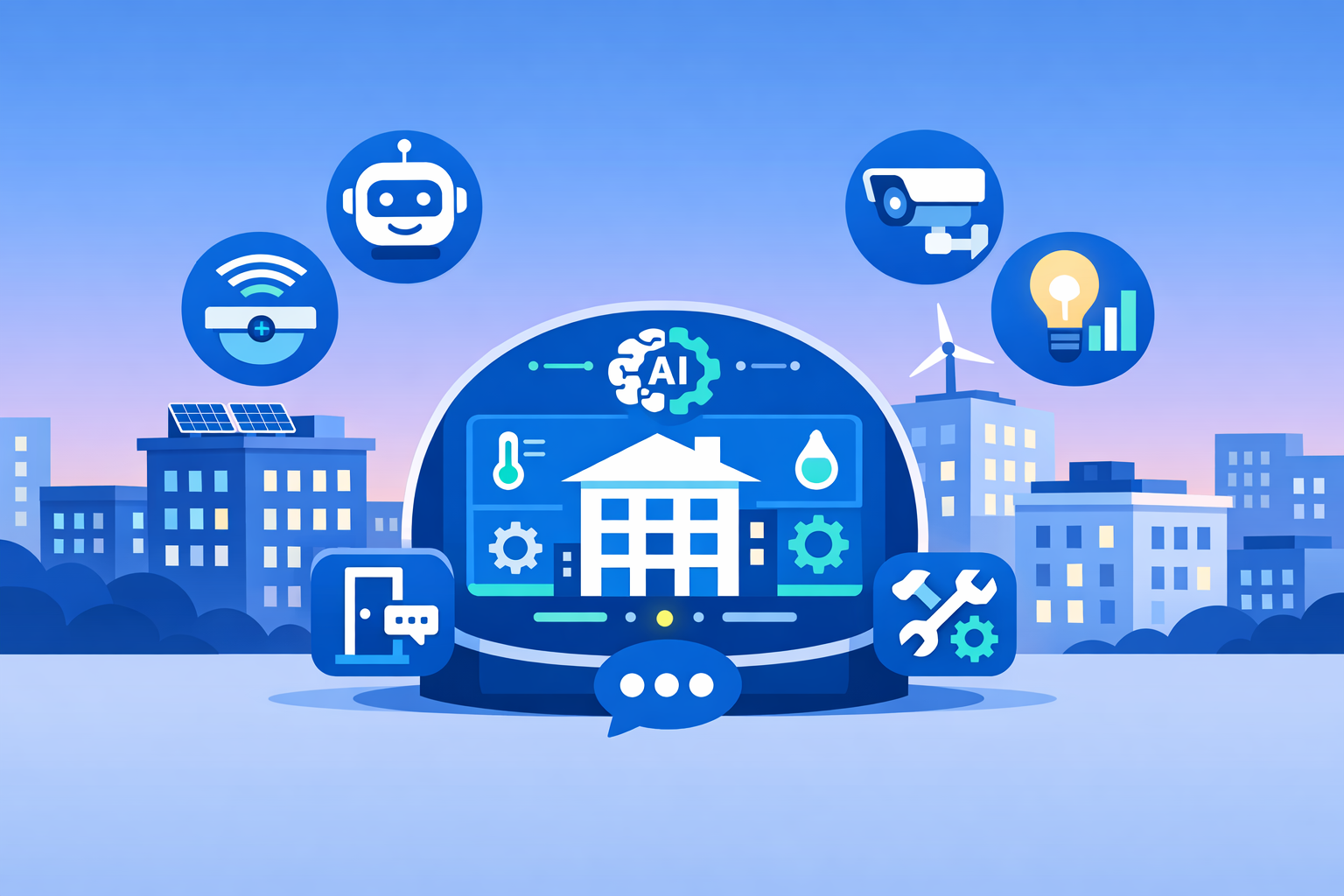
In multifamily housing, autonomy operates across several layers:
- Digital front door: smart access, visitor management, self-guided tours
- Operational backbone: predictive maintenance, work-order routing, energy management
- Resident interface: AI leasing agents, chatbots, workflows for rent and delinquency
- Perimeter and safety: sensor networks, camera analytics, patrol robots
The critical question is how far these layers can scale before on-site staff presence is a choice rather than a necessity.
Where AI Is Already Operating with Minimal On-Site Staff
Leasing and Self-Guided Tours
Self-guided tour platforms support unaccompanied prospect visits, using identity verification, smart locks, and time-bound access codes. SmartRent's Self-Guided Tours explicitly allows prospects to tour homes "with no on-site staff needed" during appointments.One SmartRent customer reported a 104.3% return on investment from self-guided tours[2]
Tour24 indicates that nearly 40% of its self-guided tours occur outside regular business hours when leasing offices are closed, signaling a shift of leasing activity to "staffless" periods.[3]
AI leasing agents such as EliseAI now handle inquiries, tour scheduling, follow-ups, and aspects of the delinquency workflow through chat, email, and phone. Advenir Azora, managing over 13,000 units, achieved a 16% lead-to-application rate after centralizing leasing with EliseAI across its portfolio.[4]
Maintenance, Energy, and Smart Building Technology
AI and IoT technologies monitor HVAC, pumps, and plumbing, generating work orders before failures. Industry analysis finds predictive maintenance in building systems can reduce unplanned HVAC failures by 40-60% and lower maintenance operating expenses by double digits.[5]
Energy-centric smart building technologies are also converging with AI. Vendor roadmaps predict AI-driven building operations will become standard, with algorithms dynamically adjusting HVAC loads and occupancy-based setpoints. Studies indicate AI-optimized HVAC can reduce energy costs by up to 25% in commercial buildings, a figure relevant in multifamily decarbonization contexts.[6]
These tools enable leaner on-site maintenance, with centralized teams responding to alerts and dispatching technicians when required.
Security, Access, and Common-Area Management
Security robots are already in use at some residential properties. Knightscope's K5 robots, for instance, monitor parking and perimeters of US apartment complexes. A Las Vegas multifamily property reported a reduction in 911 calls following the deployment of a Knightscope robot, though causality has not been independently established.[7]
Combined with camera analytics, license-plate recognition, and smart intercoms, these solutions allow centralized security centers to supervise multiple sites, particularly during overnight and off-peak hours previously reliant on physical patrols.
ROI and Operating Model: What the Numbers Suggest
Emerging trends from pilots and case studies include:
| Operational area | AI / automation use case | Reported impact range* |
|---|---|---|
| Leasing & tours | Self-guided tours, AI leasing agents | +10-20% more tours without headcount; >100% ROI in some SGT programs |
| Maintenance | Predictive maintenance, automated triage | 15-30% maintenance cost reductions; 40-60% fewer unplanned failures |
| Utilities & energy | AI HVAC optimization, occupancy sensing | 10-25% reduction in energy spend |
| Security & safety | Autonomous patrols, video analytics | Fewer incidents and calls reported in select deployments |
*Ranges synthesized from vendor case studies and industry research; actual results vary by asset class, baseline operations, and data quality.[2]
For portfolios facing labor constraints, AI property management enables centralized or hub-and-spoke staffing: regional teams oversee multiple communities, with automation handling routine monitoring and tenant interactions.
Risk, Compliance, and Resident Experience Constraints
Fair Housing, Screening, and the EU AI Act
Automated tenant screening and pricing systems have produced discriminatory outcomes, drawing regulatory scrutiny.OECD AI incident database documents cases where automated tenant screening tools resulted in unjust denials for protected groups.[8]
Under the EU AI Act and similar frameworks, AI used for credit decisions, tenant screening, and key housing actions is classified as "high-risk" and subject to strict transparency, governance, and human oversight standards.[9] As a result, fully autonomous leasing decisions-without substantive human review-carry legal and reputational risks.
Tenant Rights, Data, and Surveillance
Research into rental technology underscores the sensitivity of tenant data, including behavioral telemetry and access logs. Recent studies highlight mismatches between tenancy laws and the capabilities of AI-driven rental platforms, warning of difficult-to-contest "black box" decisions.[10]
Digital rights groups are also concerned that "landlord tech"-algorithmic rent-setting, screening, and surveillance-could erode privacy and worsen housing inequality.
Safety and Incident Response
While autonomous systems detect anomalies, human responsibility remains essential for fire, medical, and criminal incidents. Guidance from housing and regulatory bodies stresses that AI systems should:
- Triage and escalate hazards, not resolve complex welfare cases
- Maintain comprehensive, auditable action records
- Ensure human oversight for eviction, compensation, and serious complaints[11]
These requirements constrain "staffless" operations: properties may be unattended for extended periods but cannot be ungoverned.
A Realistic Roadmap: From Augmented to Semi-Autonomous Properties
Industry frameworks for "autonomous buildings" outline maturity stages applicable to multifamily housing.For instance, Cisco's 2025 smart-building model describes a progression from manual to data-driven to fully autonomous operations, integrating AI-driven energy management and reinforcement learning across building systems.[12]
A practical roadmap for multifamily owners generally follows:
- Digitized operations - Implement unified property management systems, mobile work orders, and IoT metering.
- AI-augmented workflows - Deploy chatbots for residents and prospects, automate maintenance triage, provide basic energy analytics.
- Remote-first management - Roll out self-guided tours, centralized call centers, and portfolio-wide monitoring from a command hub; reduce on-site hours.
- Semi-autonomous properties - Enable overnight and off-peak operation without on-site staff, relying on AI for detection and escalation, roving technicians, and regional managers for exception handling.
In this model, properties operate safely for extended periods without on-site staff if clear governance determines when and how humans intervene.
Actionable Conclusions and Next Steps for Owners
For owners and asset managers evaluating autonomous property management pilots, the following steps are becoming standard:
- Start with a focused use case - For example, implement self-guided tours at one property or predictive HVAC maintenance, using clear KPIs such as occupancy rates, OPEX reductions, or complaint volume.
- Design a control framework upfront - Establish human oversight for screening, rent changes, incident response, and tenant-impacting decisions.
- Standardize data governance - Document what resident and building data is collected, its purposes, and how it is logged, retained, and audited across AI systems.
- Align with emerging regulation - Map AI use cases against high-risk classifications in the EU AI Act, Fair Housing regulations, and local tenancy law; document compliance measures.
- Pilot remote-first, not staffless, operations - Begin by reducing on-site hours and transitioning to regional teams supported by automation rather than eliminating staff.
In the medium term, AI property management is likely to yield lean, centralized, semi-autonomous portfolios rather than fully autonomous buildings with no on-site staff.
Frequently Asked Questions
How close is the industry to fully staffless multifamily properties?
Available deployments support extended intervals without on-site staff-especially for tours, overnight security, and routine maintenance triage-but complete staff elimination is uncommon. Legal requirements for human involvement in screening, safety, and conflict resolution mean that, in most jurisdictions, full governance automation is not permitted even if routine tasks are automated.
Which AI use cases in property management deliver the fastest ROI today?
Vendor and case study evidence points to self-guided tours, AI leasing agents, and predictive maintenance as delivering the quickest returns. Self-guided tours drive increased activity without more leasing staff; predictive maintenance and AI-managed HVAC reduce unplanned downtime and energy costs, improving net operating income.[2]
What are the biggest regulatory risks in AI-enabled property management?
Key risks involve algorithmic tenant screening, dynamic rent-setting, and automated adverse decisions-like non-renewals or evictions-without strong human review. Under the EU AI Act and existing rights frameworks, these are high-risk areas requiring transparency, fairness assessments, documentation, and human oversight.[9]
How should owners think about resident acceptance of AI and automation?
Resident sentiment is mixed. Many renters appreciate faster service, flexible tours, and digital access, but express concern over opaque screening algorithms and pervasive surveillance. Open communication regarding system adoption, data practices, and avenues for escalation to human staff is increasingly important for building trust.
What operating model changes are required to scale AI-driven, remote-first management?
Scaling autonomous building capabilities requires:
- Centralized operations hubs for multi-property oversight
- Standardized processes and data models across the portfolio
- Revised staffing, shifting from full-time on-site roles to regional specialists
- Incident playbooks defining human intervention protocols
Organizations integrating AI as a core element of the enterprise operating model-rather than treating it as isolated tools-are positioned to realize efficiencies while maintaining regulatory and reputational compliance.