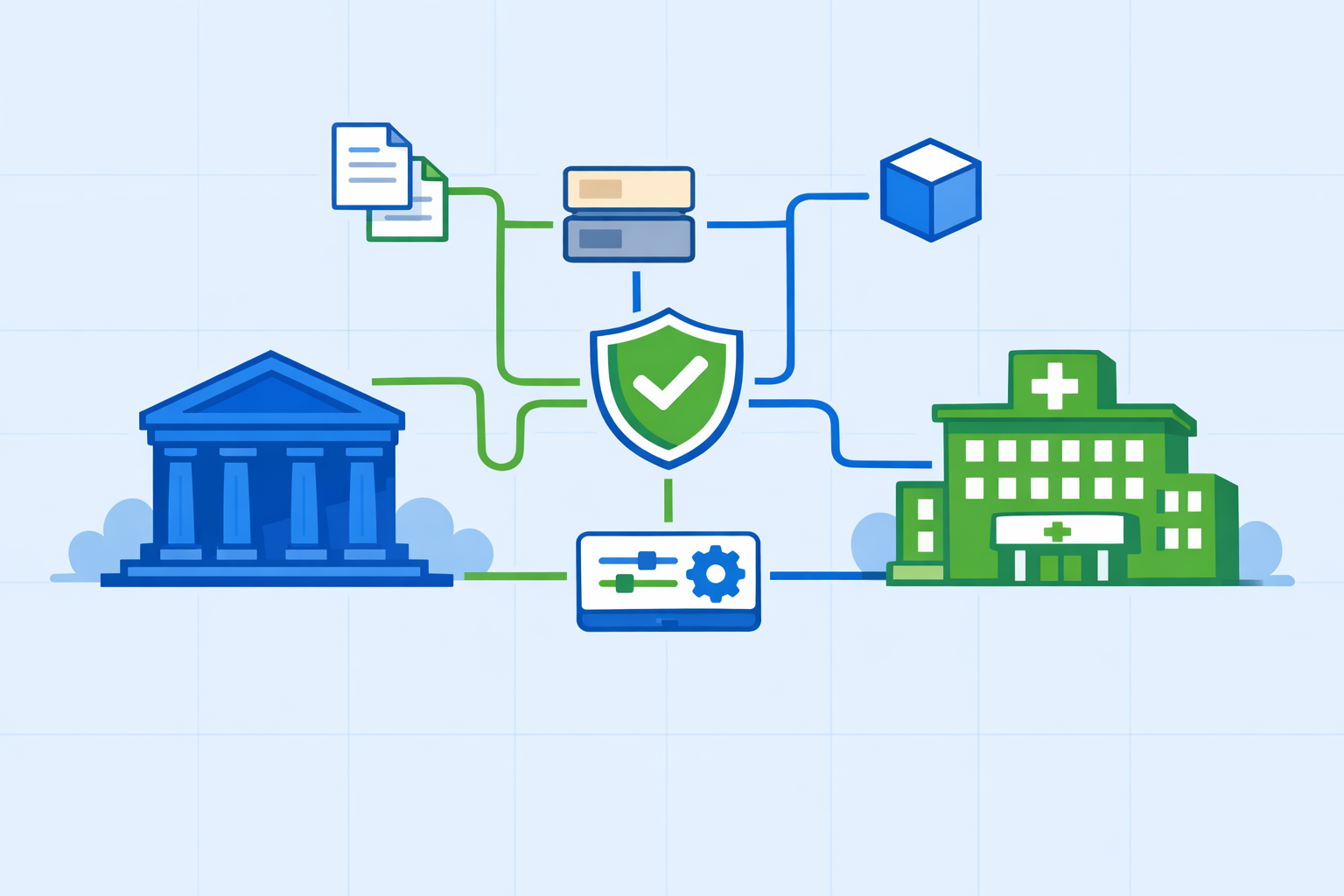
Regulators on both sides of the Atlantic are tightening requirements for how banks and healthcare organizations document, trace, and audit AI-driven decisions - a shift forcing enterprise no-code automation platforms embedded in ERP and workflow systems to demonstrate robust data lineage and access controls at scale.
Regulatory Background
Compliance pressure is compounding across jurisdictions. On April 17, 2026, the Federal Reserve, FDIC, and OCC rescinded SR 11-7, OCC 2011-12, FIL-22-2017, and related BSA/AML issuances, replacing them with a more explicitly risk-based, principles-driven framework for model risk management. The update reflects a broader view that models are central to bank decision-making and that model risk must be governed with the same rigor as credit or market risk - with model inventories tiered by materiality, controls applied proportionately, and the full lifecycle defensible end to end.
Generative AI and agentic AI systems are explicitly carved out of scope in the current revision, with the agencies noting these technologies are "novel and rapidly evolving" - but a request for information on AI and generative model risk is expected to follow. Meanwhile, OCC examiners are already rejecting black-box AI models during validation, even when those models outperform traditional scorecards on every performance metric. The Comptroller's Handbook on Model Risk Management now explicitly requires that model logic "can be reasonably understood by qualified individuals."
In Europe, healthcare organizations face parallel tightening. Phased implementation of the European Health Data Space (EHDS) began in March 2026, introducing new obligations for organizations handling health data - including requirements for interoperability, access controls, and detailed logging of electronic health records - with significant impact on healthcare and life sciences vendors. These obligations layer on top of the EU AI Act, which entered enforcement in phases starting February 2025 and requires providers of high-risk AI systems to maintain technical documentation covering traceability of training, validation, and testing data.
On the U.S. healthcare side, in September 2025, the Joint Commission partnered with the Coalition for Health AI (CHAI) to release the first comprehensive guidance for responsible AI adoption across U.S. health systems - a collaboration between the accrediting body for over 23,000 healthcare organizations and a coalition representing nearly 3,000 member organizations. By 2025, over 20 bills focused on regulating AI in clinical care, often requiring healthcare providers to disclose when AI is used in diagnoses, treatment recommendations, or patient communications.
Details: Governance Controls and the No-Code Accountability Gap
The regulatory convergence carries specific technical obligations. Sound AI data management requires versioning training datasets, labeling data with appropriate metadata, and maintaining logs of data access and transformations in AI workflows. Lineage tracking must ensure that every AI-driven decision can be traced back to its source data, model version, and applied policies.
This requirement creates a direct challenge for enterprise no-code automation. Democratized AI development has shifted value creation to business analysts, with no-code machine learning tools enabling business users to build predictive models, configure agentic workflows, and deploy automation - eliminating the constraint of scarce data science talent. However, the same accessibility that drives adoption also multiplies the surface area that compliance and risk teams must govern.
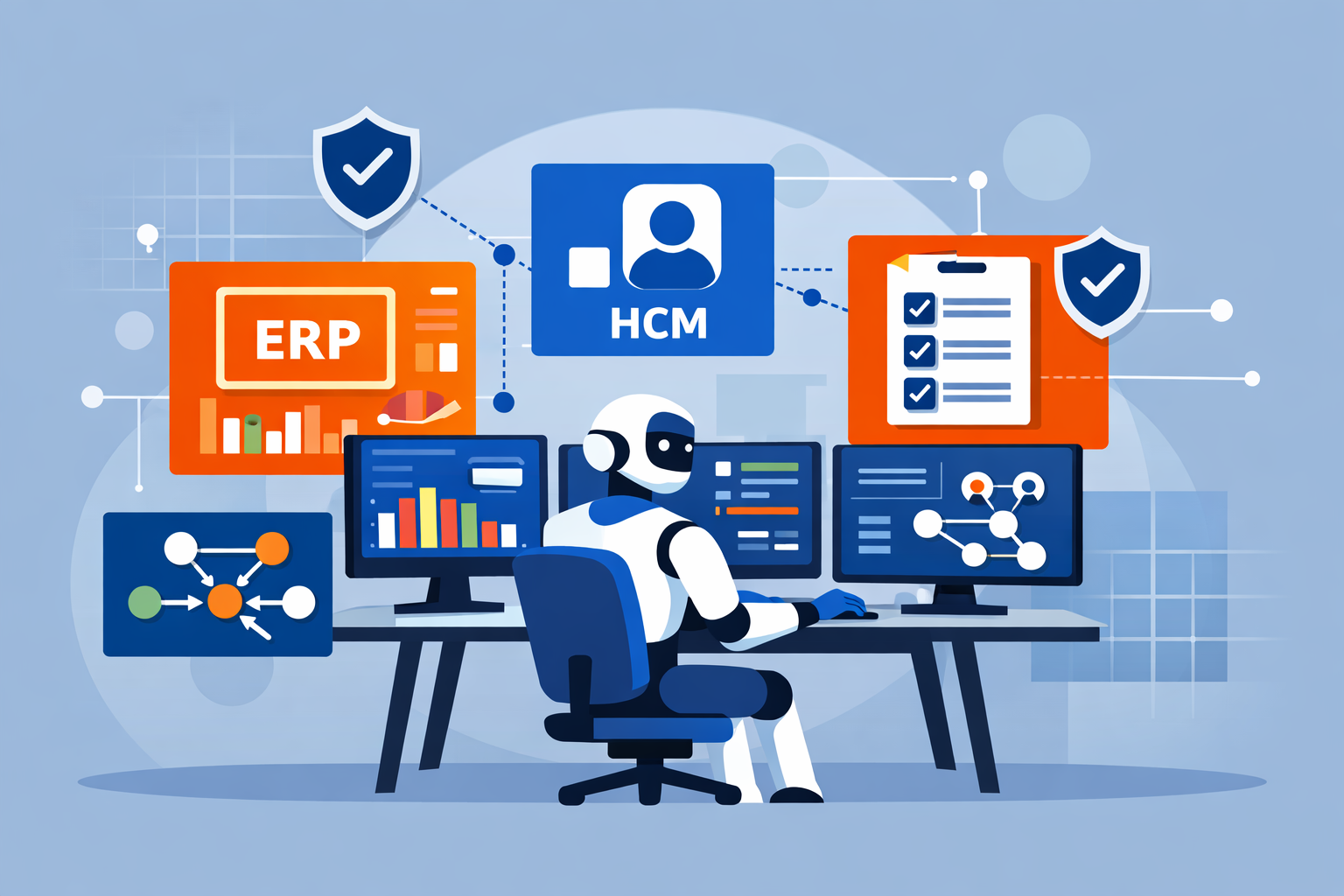
Enterprise no-code AI differs from consumer tools in scope and expectation. Enterprise platforms must handle large-scale data ingestion, integrate with existing ERP and CRM systems, enforce governance policies, provide audit trails, and deliver performance at the volume enterprise workloads demand. Platforms such as Microsoft Power Platform, Google Vertex AI with AutoML, DataRobot, and H2O.ai have invested in enterprise-grade features including role-based access controls, data lineage tracking, model versioning, and API integration layers.
Major ERP vendors are responding with embedded governance architectures. Platforms that embed AI within core ERP frameworks under unified security, permissions, and audit controls avoid the architectural complexity, governance gaps, and user-experience fragmentation that characterize point solutions. Oracle's AI agents, for example, are embedded directly into Fusion Cloud application workflows - not presented as a separate chatbot or overlay - meaning agents operate with full awareness of business process context, security settings, and data access controls.
According to a Wolters Kluwer Q1 2026 survey, 58.8% of banks cite clearer regulatory guidance as their top barrier to advancing model risk management for AI. A separate analysis estimates that 70% of enterprises lack adequate lineage visibility, yet most high-risk AI systems will require full technical documentation under the EU AI Act under penalty of €35 million or 7% of global annual turnover.
Cross-border data flows add further complexity. China clarified cross-border data transfer rules in 2024-2025, signaling national standards with technical safeguards for overseas processing, while multinational providers must keep residency and transfer logic current in code, not only in contracts.[1]
Outlook
In 2026, compliance frameworks including the EU AI Act, the NIST AI Risk Management Framework, and ISO/IEC 42001 are defining how organizations design, deploy, and monitor AI systems. Model risk management teams at banks must extend their frameworks to address AI-specific challenges without abandoning the three-pillar structure of independent validation, ongoing monitoring, and documentation. For healthcare organizations and financial institutions deploying no-code AI within ERP and workflow platforms, the governance burden now falls squarely on vendor architecture choices and internal data stewardship programs - not solely on legal or compliance teams.