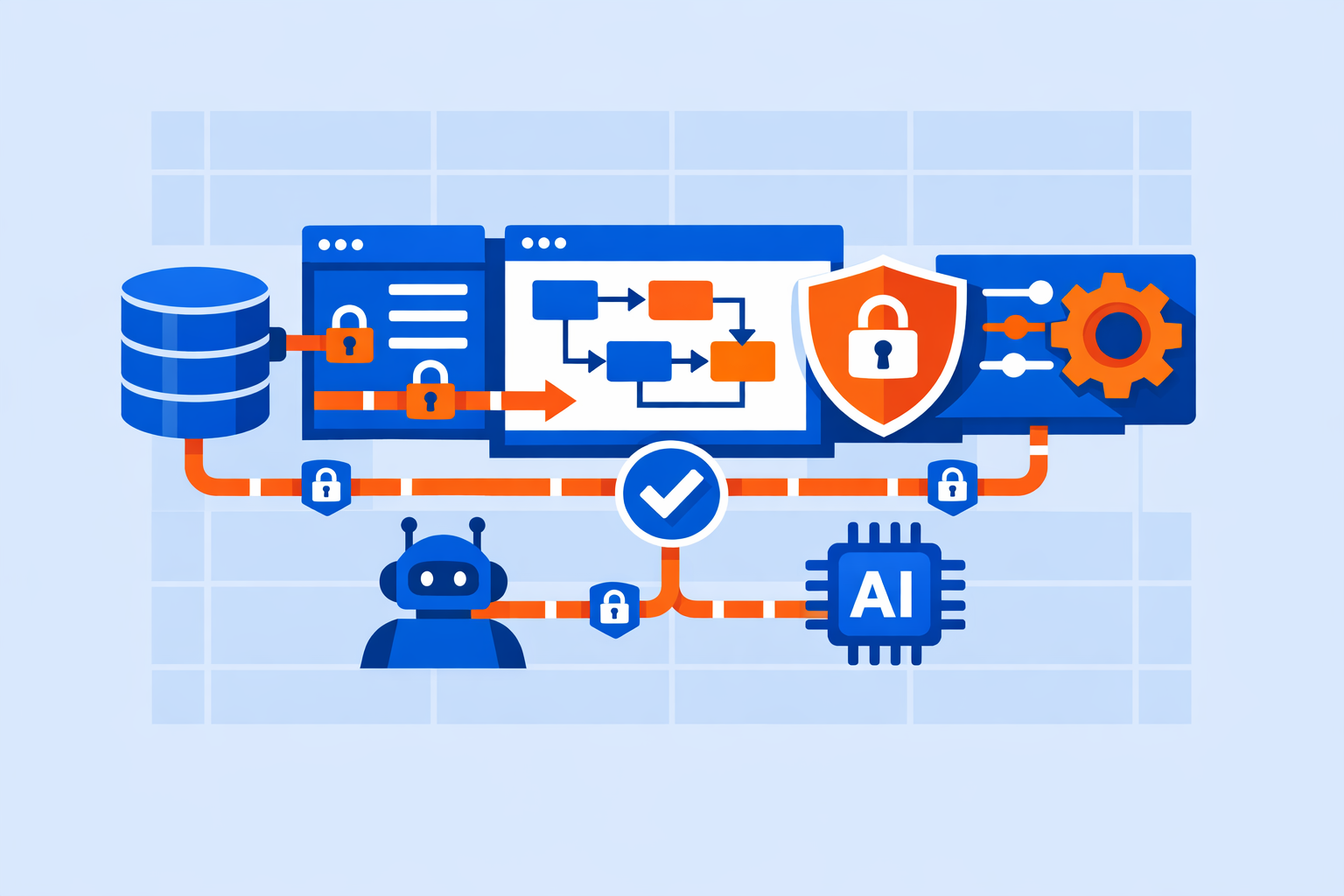
Autonomous AI is transitioning from experimental phases to regulated, mission-critical operations. Regulators are establishing that data governance is now essential. Across jurisdictions and sectors, legal frameworks and supervisory guidance converge on a core message: reliable, safe autonomous AI requires demonstrable control over data quality, lineage, access, and usage.
This article examines how emerging AI governance regimes translate into specific data governance expectations, and what a pragmatic baseline entails for enterprises deploying autonomous AI in back-office and customer-facing workflows.
Autonomous AI Enters the Regulatory Mainstream
Autonomous and "agentic" AI systems-capable of executing transactions, updating records, or triggering workflows-are integrating into financial services, healthcare, and public sector operations. Regulators increasingly treat AI governance, particularly data governance, as an infrastructural discipline, not a policy supplement.
The EU AI Act (Regulation (EU) 2024/1689) entered into force on 1 August 2024 and will be fully applicable from 2 August 2026, with phased timelines for prohibited practices, general-purpose AI, and high-risk AI systems.[1] For high-risk AI, the Act requires risk management, high-quality datasets, logging for traceability, documentation, human oversight, and robustness and cybersecurity controls before market deployment.[1]
Regulatory expectations extend beyond Europe. The U.S. National Institute of Standards and Technology (NIST) positions governance as a continuous requirement in its AI Risk Management Framework (AI RMF), released as version 1.0 in January 2023. The AI RMF is voluntary but defines "Govern" as a core function, emphasizing ongoing oversight of AI risks across the system lifecycle and at all organizational levels.[2] Singapore's Infocomm Media Development Authority (IMDA) has updated its AI governance instruments for agentic AI, citing risks from systems accessing sensitive data and autonomously changing digital environments.[3]
Collectively, these frameworks indicate that autonomous AI must meet the same evidentiary standards as other mission-critical systems-with data governance at the core.
Data Governance as the Control Plane for Autonomous AI
Data Quality, Provenance, and Lineage
For autonomous AI, data governance is framed as a "control plane" that renders data flows observable, auditable, and accurate.
Under the AI Act, high-risk AI systems must use datasets designed to minimize discriminatory outcomes and log activities for traceability. The European Commission underscores high-quality datasets, logging, and documentation as obligations for high-risk AI, together with human oversight and robustness.[1] This positions data lineage and provenance as operational requirements.
Recent guidance for risk and compliance leaders highlights this evolution. A March 2026 analysis in Risk Management Magazine notes that as new AI laws take effect, auditors require technical evidence, not just policy documentation. Key requirements include:
- Model cards documenting architecture, intended use, performance, risks, and training data characteristics.
- Data lineage capturing the full lifecycle of model data: sources, transformations, access controls, and model usage.
- Centralized catalogs of AI models with versioning, risk documentation, and formal change-management.[4]
Such capabilities support post-incident analysis (e.g., tracing a decision to an upstream data change), regulatory reporting, and internal accountability in autonomous AI.
Policy, Access Control, and Data Minimization
Data governance for AI is increasingly defined by explicit data usage policies tied to legal bases, business purposes, and enforceable technical controls.
Under the EU's General Data Protection Regulation (GDPR), Article 25 requires "data protection by design and by default," obligating controllers to embed data minimization and privacy safeguards systemically.[5] This intersects directly with AI governance. Organizations must demonstrate not only adequate model performance but also that personal data used for training and inference is restricted to what is necessary, accessed only by authorized roles, and processed according to stated purposes.
Practically, enterprises increasingly:
- Define machine-readable data usage policies, mapping data categories to AI purposes and legal bases.
- Implement granular access controls and masking for sensitive attributes across data lakes, feature stores, and vector databases.
- Log policy decisions and access events to detect and investigate policy violations (e.g., agents querying out-of-scope data).
For autonomous agents orchestrating multiple tools and data sources, policy enforcement must operate at both the data platform and orchestration layers.
Privacy by Design Across AI Pipelines
Privacy by design has shifted from a general principle to specific engineering expectations for AI systems. Regulators and standards bodies require privacy measures across all phases of the AI pipeline-collection, labeling, training, inference, and monitoring.
European data protection authorities clarify in Article 25 guidance that privacy by design and default requires technical and organizational measures tailored to each processing context.[6] For AI, this often involves:
- Purpose-bound data pipelines, with clear separation among datasets for training, evaluation, and runtime personalization.
- Systematic pseudonymization, minimization, and aggregation, especially in training data.
- Differential logging approaches that balance accountability and debugging with limited personal data retention.
As autonomous AI increasingly mediates customer interactions and operational decisions, privacy-by-design requirements become integral to both AI compliance and model risk management.
Model Risk Management Extends to Data and Autonomy
From Traditional Model Risk to AI/ML and Agentic Systems
Financial regulators first formalized model risk management (MRM) and now adapt these expectations for AI and autonomous behavior.
The Basel Committee's 2022 newsletter on artificial intelligence and machine learning notes that AI/ML deployment increases data-related and cyber risks due to large datasets, third-party interconnections, and cloud adoption, and stresses explainability and governance structures for AI/ML models.[7] Supervisors such as Germany's BaFin have highlighted that data strategy, data governance, and validation must be integrated into development and deployment of machine-learning risk models.[8]
Canada's Office of the Superintendent of Financial Institutions (OSFI) now explicitly ties AI model risk to enterprise data governance. Revised Guideline E-23 states that model risk governance should align with enterprise-level data governance, strategy, and management, and highlights monitoring challenges in complex AI/ML models.[9] This approach broadens MRM from a model-centric to a data- and lifecycle-centric framework.
Agentic AI introduces new regulatory questions. Singapore's Model AI Governance Framework for Agentic AI, released in January 2026, focuses on agents' access to sensitive data, autonomous actions in digital systems, and oversight boundaries.[3] This approach is likely to influence other financial and public sector regulators as agentic architectures become more prevalent.
Operational Monitoring: Drift, Manipulation, and Incident Response
Autonomous AI alters risk profiles from static model deployment to continuous operation amid changing conditions. Data governance underpins operational monitoring.
Recent risk management analyses emphasize tracking model drift (changes in input data distributions), concept drift (changes in input-outcome relationships), and upstream data changes that could degrade model performance.[4] For high-risk or regulated cases, expectations are shifting toward:
- Baseline performance metrics and acceptance thresholds per model and use case.
- Ongoing data quality checks on production data against established rules.
- Lineage-based alerting when upstream schemas, sources, or transformations change.
The EU AI Act mandates activity logging for traceability and post-market monitoring of high-risk AI systems, including mandatory reporting of serious incidents and malfunctions.[1] NIST's AI RMF also requires contingency processes for failures in third-party data or designated high-risk AI.[10] Effective incident response for autonomous AI depends on rapid access to lineage and policy logs tracing data, prompts, and actions.
Regulatory and Standards Landscape: Convergence on Data Governance
EU AI Act: Codifying Data, Logging, and Transparency
The AI Act currently stands as the most detailed cross-sector AI regulation, offering a clear blueprint for how legislators expect data governance to support AI safety.
Key data-related obligations for high-risk AI systems include:
- Use of high-quality datasets that are relevant, representative, and as error-free as possible to reduce discriminatory outcomes.
- Logging of system activity to support traceability.
- Technical documentation sufficient to explain system purpose, design, and limitations.
- Transparency measures enabling user interpretation of outputs.
- Ongoing post-market monitoring and incident reporting.
The Commission states that high-risk AI rules take effect in August 2026, and for certain embedded high-risk systems, in August 2027; transparency rules for many AI systems and obligations for general-purpose AI models apply starting August 2025-2026.[1] This phased timeline establishes deadlines for organizations operating in or into the EU to enhance AI data governance maturity.
NIST AI RMF, ISO/IEC 42001, and Privacy Standards
Beyond the EU, non-binding frameworks and international management standards are defining best practices for AI governance.
- NIST AI RMF 1.0: Defines "Govern" as a core function, with practices for establishing policies, roles, and processes to manage AI risks, including those from data quality, data collection, and third-party dependencies.[2] NIST has also introduced a generative AI profile addressing risks unique to foundation models.
- ISO/IEC 42001: The first international standard for AI management systems; requires organizations to establish, implement, maintain, and continually improve an AI management system, including comprehensive documentation for AI use and data governance.[11] While voluntary, this standard increasingly informs AI governance audits.
- Privacy standards and regulations (e.g., GDPR, ISO/IEC 27701): Reinforce privacy-by-design expectations and extend them to AI-related processing, including cloud and biometric data.[12]
Together, these standards form a baseline for enterprises operating across jurisdictions, even as requirements vary by sector or geography.
Cross-Framework Themes
A survey of AI regulations and frameworks reveals recurring, data-centric themes:
- Documented data governance policies and clear data ownership.
- Explicit evaluation of data biases, representativeness, and suitability for AI use.
- Requirements for data lineage, logging, and traceability to enable audits and investigations.
- Integration of AI risk with operational resilience and cybersecurity management.
- Alignment across AI governance, privacy law (e.g., GDPR), and information security standards.
| Framework / Instrument | Scope for AI | Data governance expectations relevant to autonomous AI |
|---|---|---|
| EU AI Act | Binding EU regulation for AI systems, risk-based | High-risk AI must use high-quality datasets, implement traceability logging, maintain technical documentation, and perform post-market monitoring. |
| NIST AI RMF 1.0 | Voluntary framework for managing AI risk | "Govern" function calls for policies, roles, and processes to manage AI risks, including data collection, quality, documentation, and third-party dependencies. |
| ISO/IEC 42001 | AI management system standard | Requires documented AI and data governance policies and continuous improvement of management processes. |
| GDPR Article 25 | Data protection law (EU) | Embeds privacy by design and default, requiring technical and organizational measures that minimize data processing and protect subjects. |
| Singapore IMDA Model AI Governance (Agentic AI) | Non-binding national framework | Focuses on governance of agent access to sensitive data, autonomy boundaries, and oversight for agentic behavior. |
What Governance Maturity Looks Like for Autonomous AI
For CIOs, CDOs, and risk leaders, regulatory and standards convergence defines a practical baseline that addresses both AI governance and compliance.
Indicative Data Governance Baseline
Enterprises pursuing autonomous AI in critical workflows are establishing:
- Centralized data catalog and lineage: Inventory of datasets, features, and AI models, with lineage from sources through transformations to model inputs and outputs.
- Data quality management: Defined dimensions and rules, with automated checks for completeness, accuracy, timeliness, and consistency integrated into issue management.
- Policy-aware access control: Role- and attribute-based controls enforced across data warehouses, lakes, and AI feature stores, aligned to privacy and regulatory requirements.
- Model and agent inventory: Register of models and autonomous agents, including owners, purposes, input data, output channels, risk ratings, and third-party dependencies.
- Integrated logging and monitoring: Unified logs for data access, policy decisions, model inferences, and agent actions, with retention meeting regulatory and operational needs.
Architecture Patterns for Data-Centric AI Governance
Organizations are adopting architectures that treat governance as a set of shared services:
- Governance overlay on MLOps / LLMOps: Data catalogs, lineage services, and policy engines integrated with CI/CD pipelines, model registries, and inference gateways, enabling risk-informed deployment and rollback.
- Composable controls: Privacy, security, and quality controls (masking, encryption, validation, filtering) implemented as reusable components for consistent application across models, agents, and environments.
- Policy-as-code for AI: Business and regulatory policies are machine-readable and evaluated at runtime, especially for autonomous agents orchestrating multiple tools.
These practices allow governance to scale with automation and multi-cloud environments, reducing reliance on manual checks.
Actionable Conclusions and Next Steps
Autonomous AI is accelerating the transition from abstract AI ethics to enforceable data governance. Regulations such as the EU AI Act, frameworks like NIST's AI RMF, and sectoral model risk guidance converge on the necessity of robust data quality, lineage, access control, and privacy-by-design.
Core next steps for senior IT and business leaders include:
- Establish an AI data governance program: Expand existing governance groups to include AI use cases, with input from data engineering, security, privacy, legal, and business owners.
- Consolidate AI and data inventories: Develop or refine unified inventories of AI systems and related datasets, including lineage, risk classification, and regulatory mapping.
- Align with reference frameworks: Assess current controls against the EU AI Act, NIST AI RMF, ISO/IEC 42001, and sector-specific guidance to identify gaps for autonomous or agentic AI.
- Embed governance in pipelines: Integrate data quality checks, lineage capture, and policy enforcement into data and model pipelines, minimizing reliance on periodic audits.
- Strengthen vendor oversight and data contracts: Update AI and data provider contracts to require transparency on training data, governance practices, logging, and incident response.
Treating data governance as foundational infrastructure positions organizations to demonstrate trust, comply with emerging requirements, and scale AI workflows while managing operational risk.
Frequently Asked Questions
How is data governance different from AI governance in autonomous AI deployments?
Data governance addresses collection, storage, transformation, access, retention, quality, lineage, and privacy controls for data. AI governance encompasses the model lifecycle, risk assessment, human oversight, and conformity with legal and ethical standards. In autonomous AI deployments, robust data governance supplies the evidentiary basis regulators and stakeholders require for effective AI governance.
Why is data lineage important for AI compliance and model risk management?
Data lineage provides an auditable path from data source through transformation to model input and output. Regulations such as the EU AI Act mandate logging and traceability. Financial sector expectations stress understanding how data quality and transformations affect model behavior. Without lineage, organizations cannot perform root-cause analysis, demonstrate control to regulators, or safely update models after upstream changes.
How do privacy-by-design obligations like GDPR Article 25 affect autonomous AI?
Privacy-by-design obligations mandate minimizing and protecting personal data processing from the outset. For autonomous AI, this affects data selection, feature engineering, logging, and agent action policies, which must all respect principles of minimization, purpose limitation, and security. Privacy requirements must be embedded in data pipelines and AI workflows-not addressed solely at the application level or in documentation.
What should enterprises ask AI vendors about data governance when procuring autonomous AI solutions?
When evaluating AI vendors, organizations typically clarify:
- The provenance, quality controls, and representativeness of training and evaluation data.
- Implementation and accessibility of data lineage, logging, and audit trails.
- Application of access controls, data minimization, and privacy-by-design principles.
- Incident-response processes, including access to data and logs during AI incidents.
- Alignment with the EU AI Act, NIST AI RMF, and ISO/IEC 42001 frameworks.
These inquiries ensure vendor offerings support the organization's AI governance and compliance requirements.
Is data governance for AI only relevant to regulated industries?
While regulatory pressures are strongest in financial services, healthcare, and the public sector, data governance capabilities-such as data quality, lineage, privacy controls, and logging-are increasingly expected in any enterprise deploying AI at scale. Unregulated industries also face contractual, reputational, and operational risks from AI failures, and many are subject to global privacy or consumer-protection laws. As a result, robust data governance is becoming essential for enterprise-grade autonomous AI, extending beyond compliance in regulated sectors.