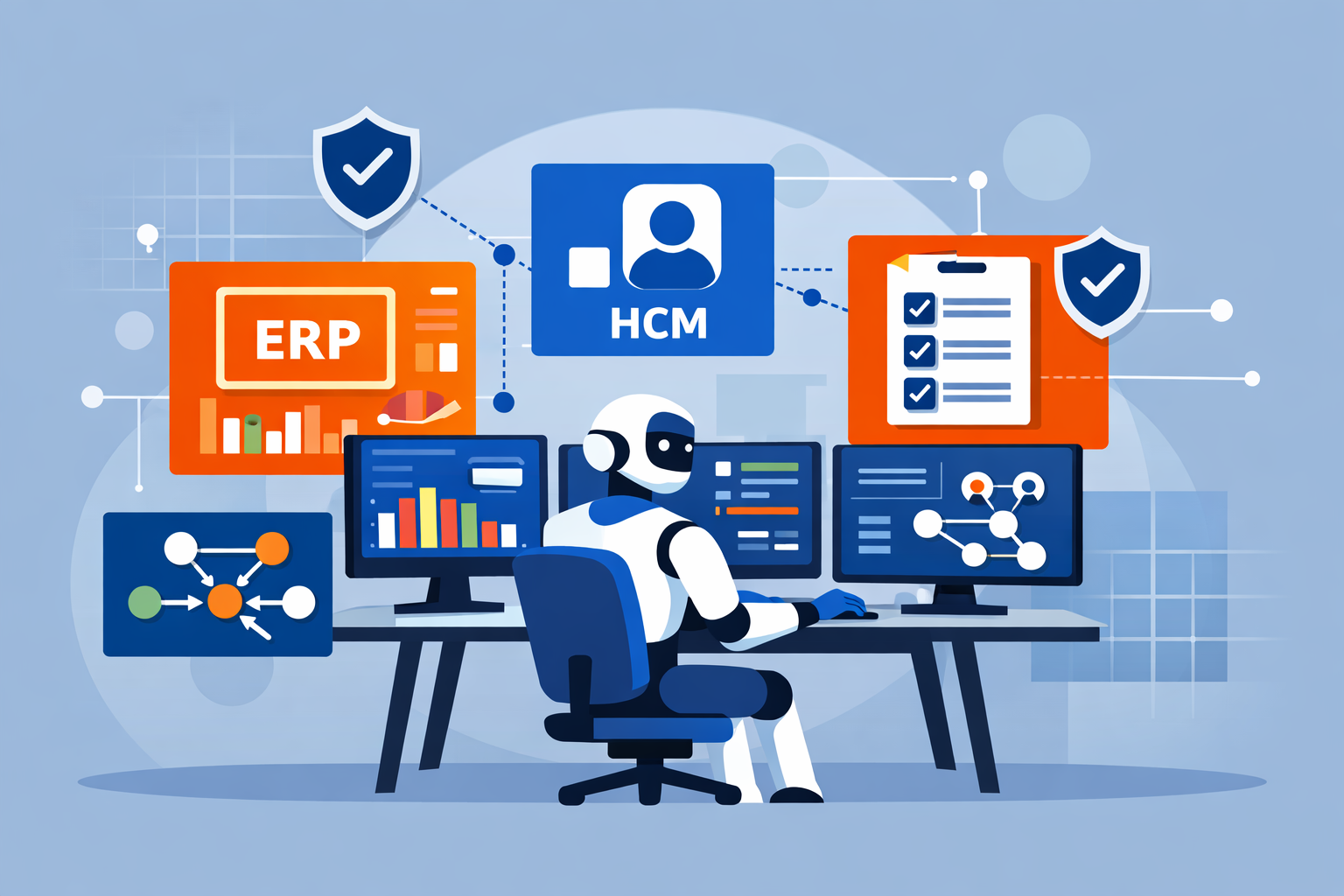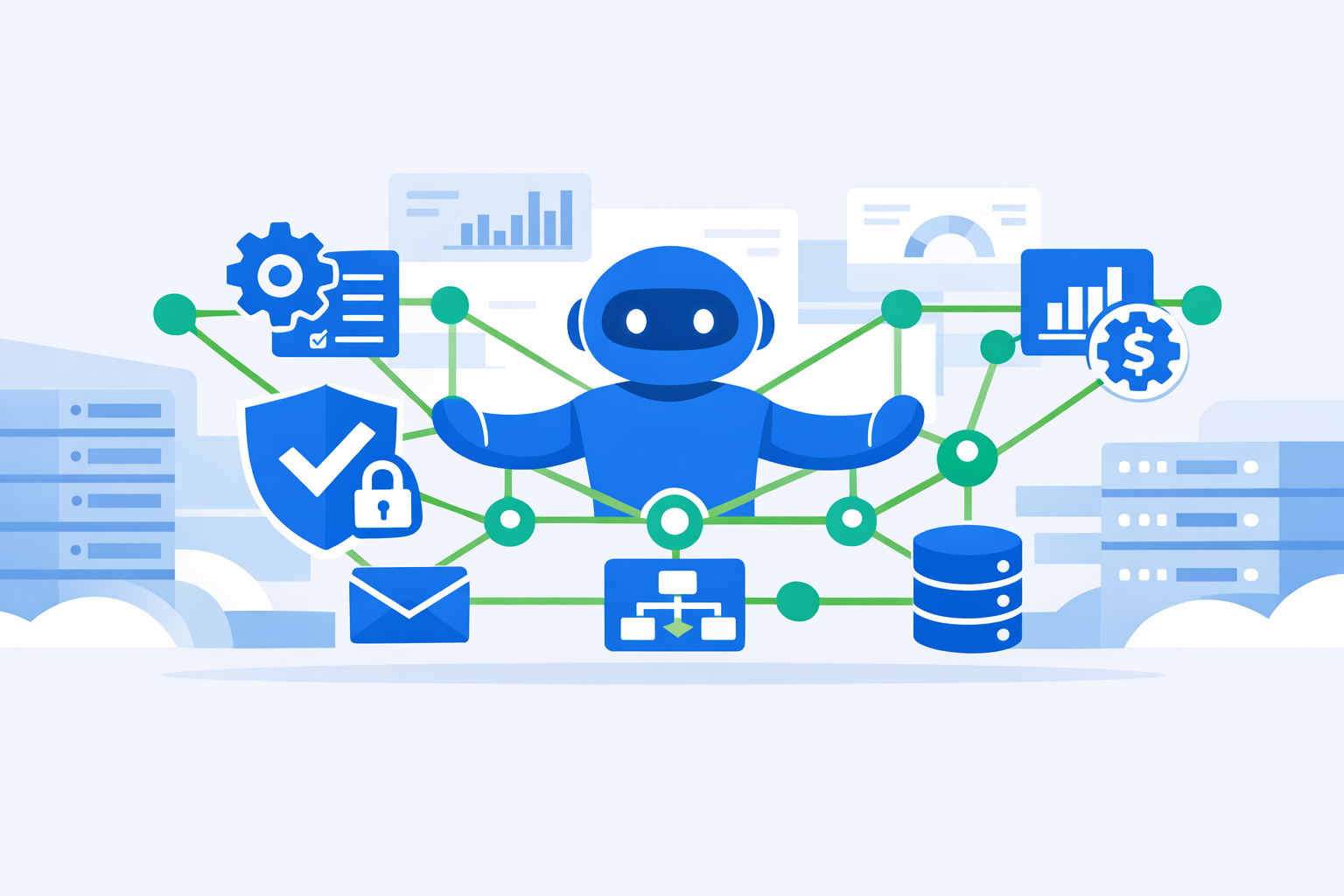
Major enterprise software vendors are embedding role-based AI agents directly into core ERP and HCM workflows at production scale, forcing organizations to address governance frameworks, cross-platform interoperability, and cost controls before those deployments can deliver sustainable ROI. The shift marks a decisive move beyond pilot programs, with integration architecture now determining competitive differentiation among platform vendors.
Background
Gartner predicts that 40% of enterprise applications will include task-specific AI agents by the end of 2026, up from less than 5% in 2025, according to analysis published by Prolifics. That trajectory is already visible in vendor roadmaps. SAP unveiled major updates at Sapphire 2025, evolving Joule from a copilot to an autonomous agent and introducing Joule Studio's AI agent skill builder. Oracle has embedded more than 600 AI agents-including 400 in Fusion Apps and 200 in Industry Apps-across Fusion Cloud ERP, SCM, HCM, and CX. Microsoft has integrated Copilot across Dynamics ERP and CRM, with agents operating in human-in-the-loop or autonomous modes powered by Azure OpenAI.
The transition from task-based to role-based agents represents the central architectural shift. Digital employees-agents that independently carry out complex tasks or full processes as virtual team members-mark the next leap after 2024's acclimation to task-based AI, operating across multiple systems. Early adopters of AI-integrated ERP systems already report EBIT improvements of 5% or more, according to McKinsey research.
Details
Vendor deployment patterns reflect both scale and specialization. Infor's agentic strategy centers on an orchestration layer that turns isolated AI agents into coordinated workflows, an industry agent library exceeding 100 purpose-built agents across eight verticals, and an AWS partnership spanning sovereign cloud infrastructure and marketplace distribution. SAP's Joule is embedded across S/4HANA, SAP BTP, SuccessFactors, Ariba, and Sales and Service Cloud.
Interoperability has emerged as the critical unsolved challenge. The Model Context Protocol (MCP), an open standard introduced by Anthropic in November 2024, defines how AI agents communicate with external systems, tools, and data sources. MCP gives agents a structured way to call enterprise software-including CRM platforms, ERP systems, and internal databases-without requiring custom integrations for each connection. When OpenAI adopted MCP in March 2025, monthly downloads jumped from roughly 100,000 to 22 million, establishing it as the de facto integration protocol for enterprise AI agents. MCP has since been donated to the Linux Foundation's Agentic AI Foundation.
Despite MCP's momentum, fragmentation persists inside large organizations. As Forrester has noted, interoperability frameworks that work across vendor boundaries do not yet exist. The result inside a typical large enterprise: dozens of AI tools deployed across business units with no shared memory or context between agents from different platforms. Where agents run on a vendor's proprietary orchestration layer, lock-in compounds at every layer of the stack.
Governance pressure is intensifying from both regulatory and operational directions. The EU AI Act entered full enforcement in early 2026, requiring human oversight hooks, explainability APIs, and conformity assessments for high-risk systems affecting employment, credit, or safety. Half of enterprise ERP vendors are projected to introduce autonomous governance modules combining explainable AI, automated audit trails, and real-time compliance monitoring-driven by rising AI regulation, mission-critical autonomous processes, and high-profile AI failures in financial services. Leading platforms already include compliance checks, testing sandboxes, and usage monitoring to ensure agents behave predictably. They also support cost control by tracking resource consumption such as LLM tokens, which is essential for scaling agentic AI.
Security architecture is evolving in parallel. Traditional perimeter security models break down the moment an AI agent receives credentials to act on behalf of a user or system. The emerging standard is Zero-Trust Agent Identity (ZTAI), under which every agent call must be authenticated, authorized, and audited independently.
Outlook
The enterprise AI agent market has passed its experimental phase. By mid-2026, over 40% of Fortune 1000 companies run at least one production AI agent workflow touching core business systems. The question is no longer whether to adopt agent platforms, but which architectural and integration criteria should govern that adoption.
End-user roles are being redefined. Rather than executing transactions, workers will collaborate with agents to set intent, validate outcomes, and intervene in exceptions. Organizations will need fewer transactional specialists but more professionals who can govern agent performance and continuously refine decision logic.
Vendors whose governance roadmaps lag will face intensifying customer scrutiny as regulated industries make compliance-ready architecture a baseline procurement requirement.