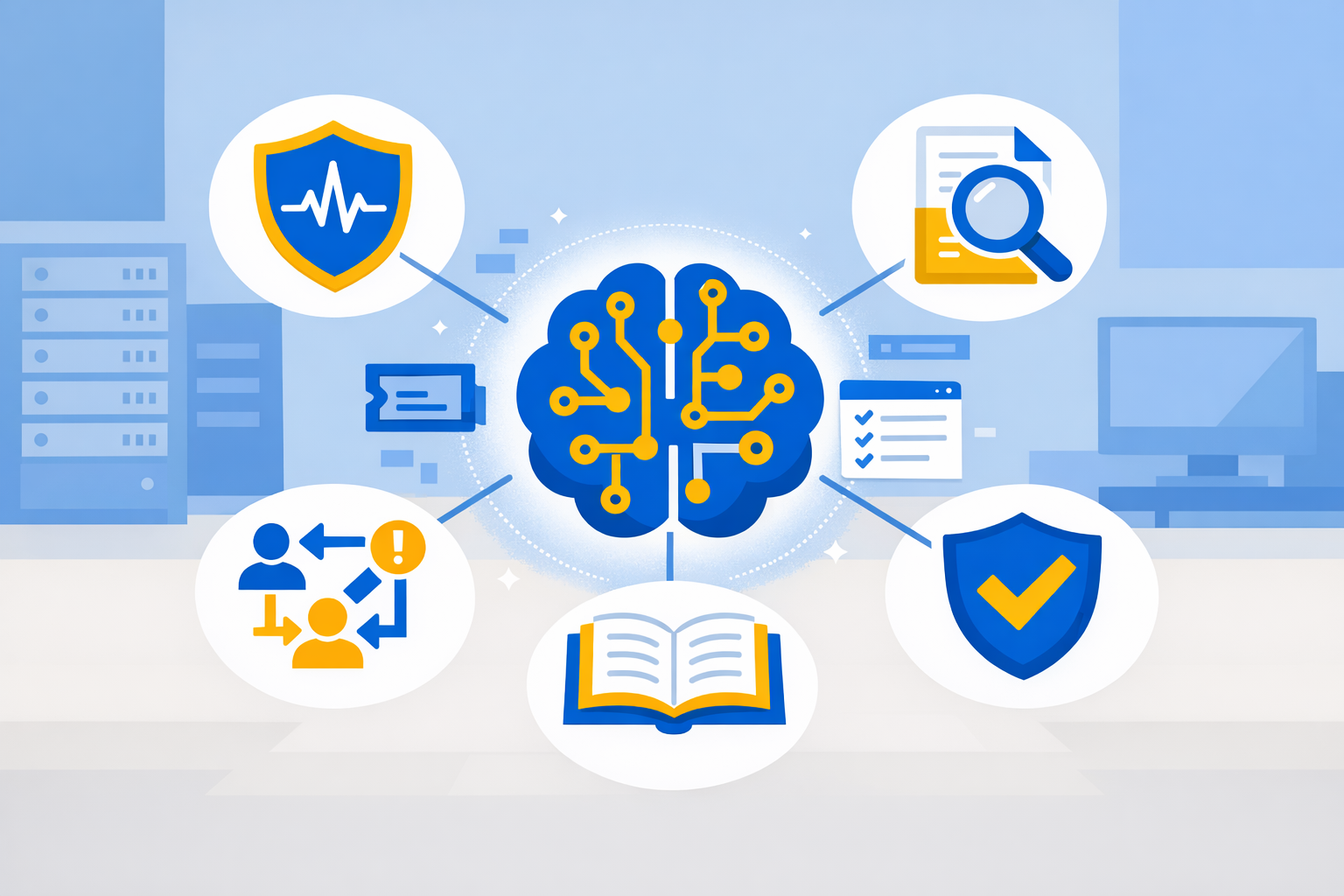
Major IT service management (ITSM) platforms have integrated five essential AI capabilities to meet enterprise IT operations' requirements for efficiency, compliance, and preventive maintenance in 2026. These capabilities-proactive incident prevention, automated root-cause analysis, intelligent routing and prioritization, contextual knowledge management, and compliance-aware automation-are designed to optimize mean time to repair (MTTR) and enhance governance across toolchains.
Background
AI now serves as a core decision-support component in ITSM workflows, no longer operating as an optional add-on. Enterprises seek robust AI features embedded within ticket intake, incident response, asset management, and monitoring processes. Key evaluation criteria focus on measurable operational impact, secure context-aware AI, and adherence to IT Infrastructure Library (ITIL) best practices[1]. Many platforms support AI-driven capabilities across collaboration channels such as Slack, Microsoft Teams, and self-service portals, emphasizing conversational interfaces, automation, and analytics[2].
Details
Proactive incident prevention is standard: AI analyzes historical incident data and monitoring telemetry to detect anomalies and enable preventive actions, in some cases reducing P1/P2 incidents by over 50%[3]. Automated root-cause analysis leverages classification, extraction, and summarization to deliver resolution recommendations and automatically generate knowledge articles[4].
Intelligent routing and prioritization enable accurate ticket theming, routing, and escalation based on language analysis, workload data, and service-level agreement (SLA) requirements, ensuring resolution consistency during demand spikes[1]. AI-driven knowledge management provides semantic search, context-aware recommendations, and automated article suggestions informed by ticket histories[5].
Compliance-aware automation enforces role-based access controls, audit trails, and policy-driven escalations. AI-powered platforms document actions for governance and integrate with identity management and SLA monitoring systems[6].
Platforms such as Freshservice, InvGate Service Management, and Siit demonstrate these features in practice. Freshservice uses AI for ticket classification, intelligent chatbots, and proactive workflow automation[7]. InvGate's AI Hub offers summarization, categorization, escalation forecasting, sentiment analysis, and automatic knowledge-article generation[4]. Siit delivers AI-first automation over collaboration tools, supporting triage, SLA management, knowledge suggestions, and analytics within Slack and Teams environments[2].
Outlook
Organizations will need to assess AI feature effectiveness across various deployment models-SaaS, on-premises, or edge-for distributed environments. Vendor ecosystems and integration options will shape risk evaluations and strategic deployment decisions. As AI adoption advances, IT leaders will prioritize features delivering proven efficiency gains, governance compliance, and interoperability across enterprise workflows.