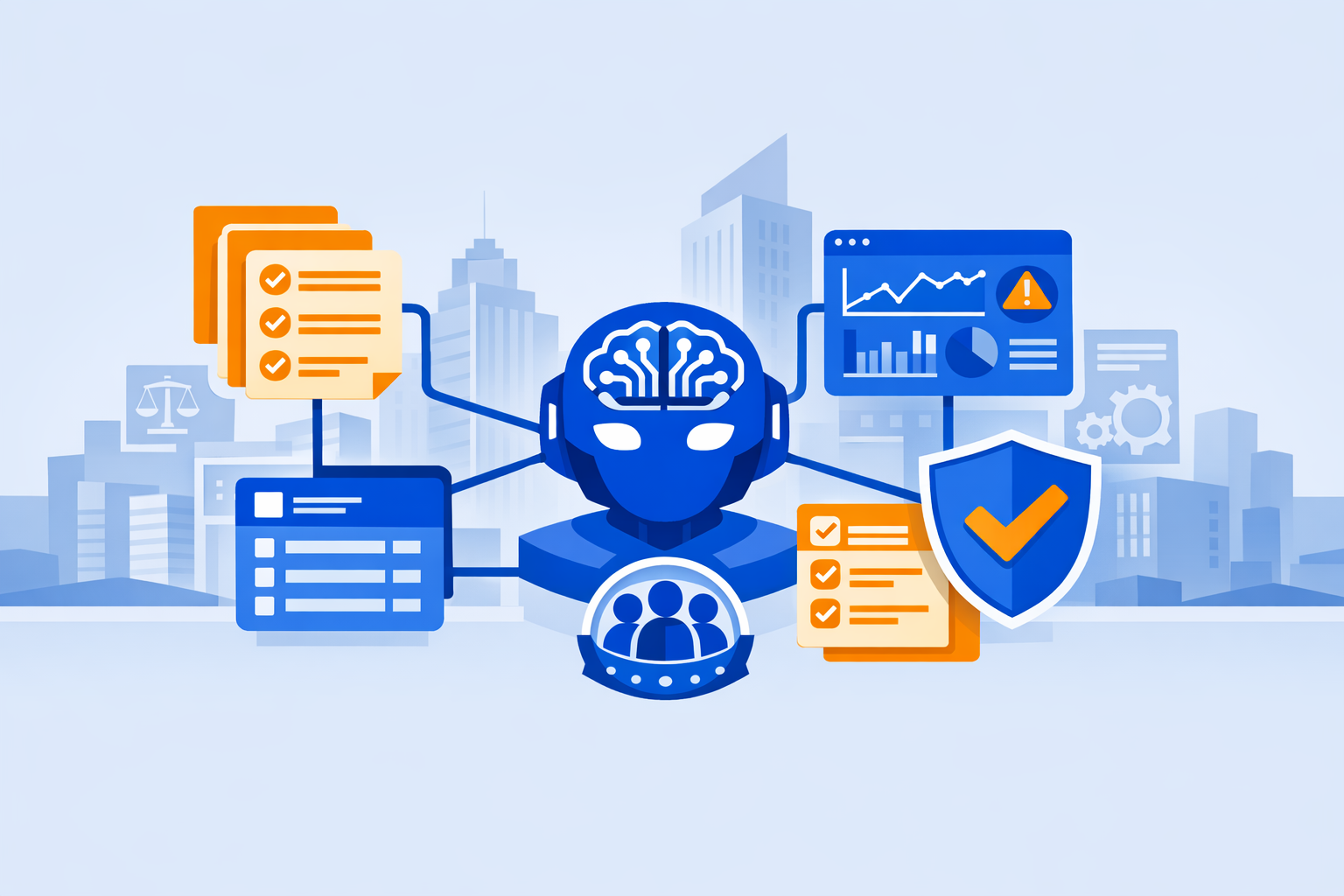
Enterprises are advancing governance frameworks to manage the increasing autonomy of AI agents. As AI systems execute complex, multi-step tasks with minimal human oversight, organizations are implementing policy registries, continuous monitoring, and incident response protocols to ensure accountability, regulatory compliance, and auditability.
Background
Autonomous AI agents, which perform self-directed actions, introduce heightened risks including regulatory non-compliance, liability gaps, and limited traceability. The EU AI Act, effective August 1, 2024, and requiring compliance by August 2, 2025, mandates that high-risk AI systems maintain transparency, robustness, and human oversight. Organizations must align governance structures with legal requirements to support operational resilience, in accordance with regulation summaries and reporting guidelines. The NIST AI Risk Management Framework (AI RMF) and ISO/IEC 42001 provide risk-based and certifiable approaches for AI oversight. These frameworks are now established references for enterprises seeking compliance.
Details
"AI Factory" models are gaining adoption by combining centralized governance-such as standardized tooling, shared infrastructure, and policy guidance-with distributed development within business units to maintain agility. In sectors like financial services and manufacturing, these models have enabled scalable governance without impeding innovation by facilitating modular oversight tailored to specific use cases.
Recent research in agentic governance includes "Policy Cards": machine-readable, runtime rule sets that embed allow/deny constraints within autonomous agents, enabling dynamic policy enforcement and auditability at deployment. Additional frameworks, such as AGENTSAFE and AURA, offer end-to-end pipelines encompassing risk identification, runtime controls, and audit capabilities-including anomaly detection, semantic telemetry, and cryptographic traceability.
Industry implementations indicate measurable benefits. Cross-functional governance teams have achieved up to a 30 percent reduction in compliance cycle times. Tiered classification systems, applying governance according to risk level, have sped deployment for low-risk applications while sustaining strict oversight of high-impact systems.
Despite these advances, gaps persist. Research indicates that only one in five enterprises currently maintain a mature governance framework for operational AI agents. Many are retrofitting audit functionality after deployment, resulting in limited traceability and increased risk exposure.
Outlook
With the EU AI Act's full enforcement set for August 2026 and expanding regulation at the U.S. state level, enterprises face growing pressure to operationalize AI governance. Organizations are expected to intensify integration of governance tools-including policy-as-code solutions and continuous review dashboards-and reinforce oversight structures, such as AI governance councils with board-level authority.