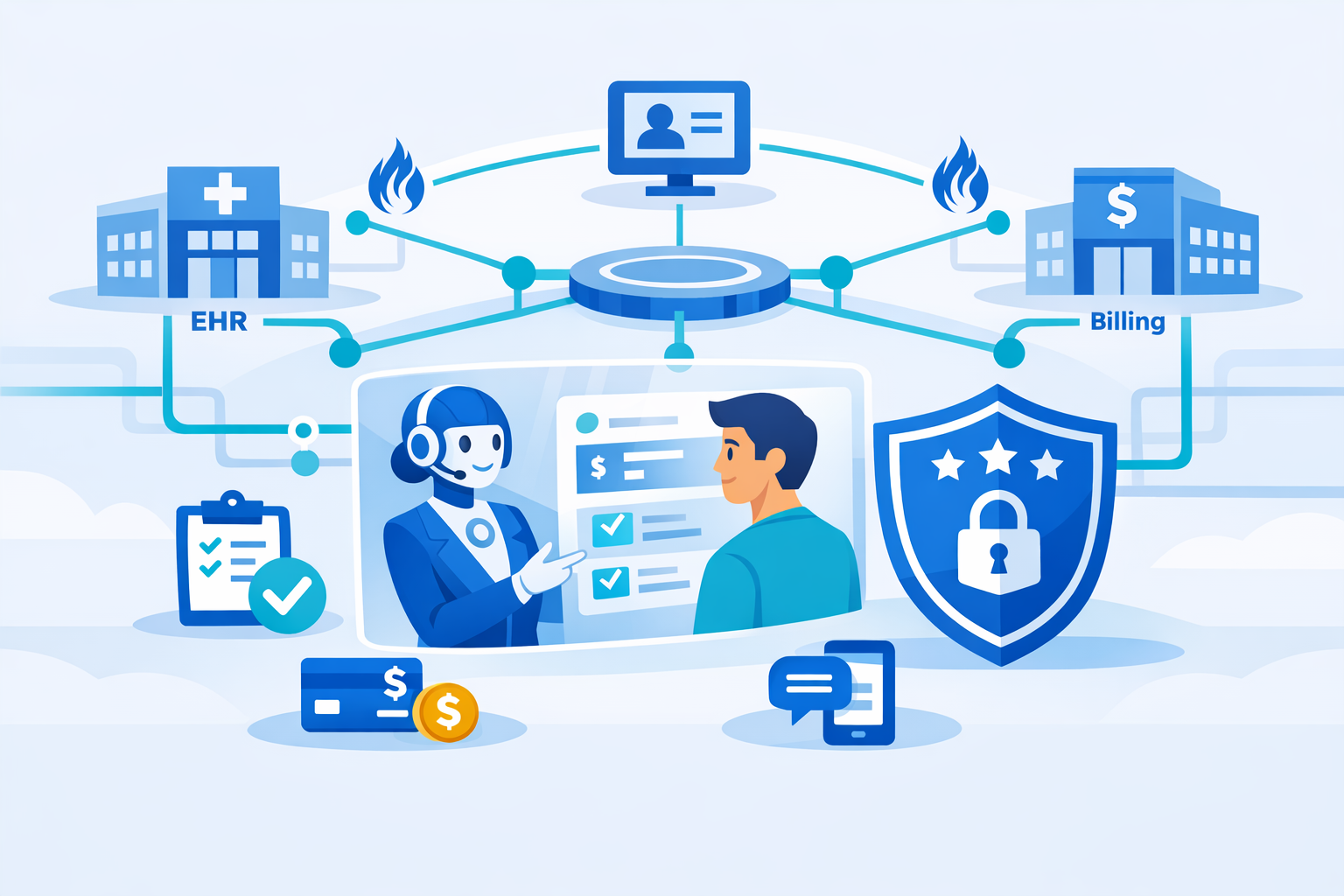
A payer-provider partnership has deployed AI agents to automate patient financial experience (PFE) workflows such as eligibility checks, payment collection, and patient communication within a governance framework aligned with HIPAA and interoperability standards. Announced this month, the initiative enforces data minimization, auditability, and model risk controls across EHRs, billing systems, and patient portals to ensure compliance and privacy.
Background
Implementing AI in healthcare finance involves navigating fragmented systems and strict regulatory requirements. According to a KPMG study, 62% of healthcare organizations identified data quality and system fragmentation as major barriers to AI adoption, while 42% reported difficulties meeting regulatory and ethical requirements for AI initiatives 62% of healthcare organizations identified data quality as a major constraint; 42% faced challenges meeting regulatory requirements for AI[1]. Expert frameworks recommend the use of HL7 FHIR (Fast Healthcare Interoperability Resources) APIs, access controls, and minimal necessary data sharing when integrating AI with EHR systems to manage privacy and compliance risks Governance frameworks call for FHIR-based exchange, restricted PHI access, and audit logging in AI integrations[2].
Details
The partnership has implemented AI-driven workflows that run eligibility checks and payment reminders through billing and EHR systems, with every interaction subject to comprehensive logging and governance. Communications and data access are facilitated via FHIR APIs, which enable resource-level access controls and support auditability, in line with HIPAA requirements System uses FHIR-based APIs with granular access controls and audit logging to maintain HIPAA compliance[2]. The governance framework enforces "minimum necessary" data principles, restricting AI agents to only essential fields and, for example, excluding unrelated billing data from eligibility checks AI agents are configured to access only necessary PHI and exclude unrelated data fields[2]. Continuous audit trails and static governance checks monitor data queries and flag potential privacy risks before deployment, aligned with model risk management best practices in AI governance [3].
Interoperability challenges persist. To address them, the project leverages platform-native capabilities: API-first architecture, data lineage tracking, and policy enforcement within storage and workflow layers. This approach enables secure orchestration across EHR, billing, and patient portal systems while supporting scalability and maintaining privacy protections.
Outlook
Healthcare organizations are expected to align governance standards with automation vendors and prioritize interoperability to ensure ongoing compliance. Sustaining automation adoption in PFE workflows will depend on continued implementation of governance-centered AI pipelines and adherence to evolving regulatory requirements.