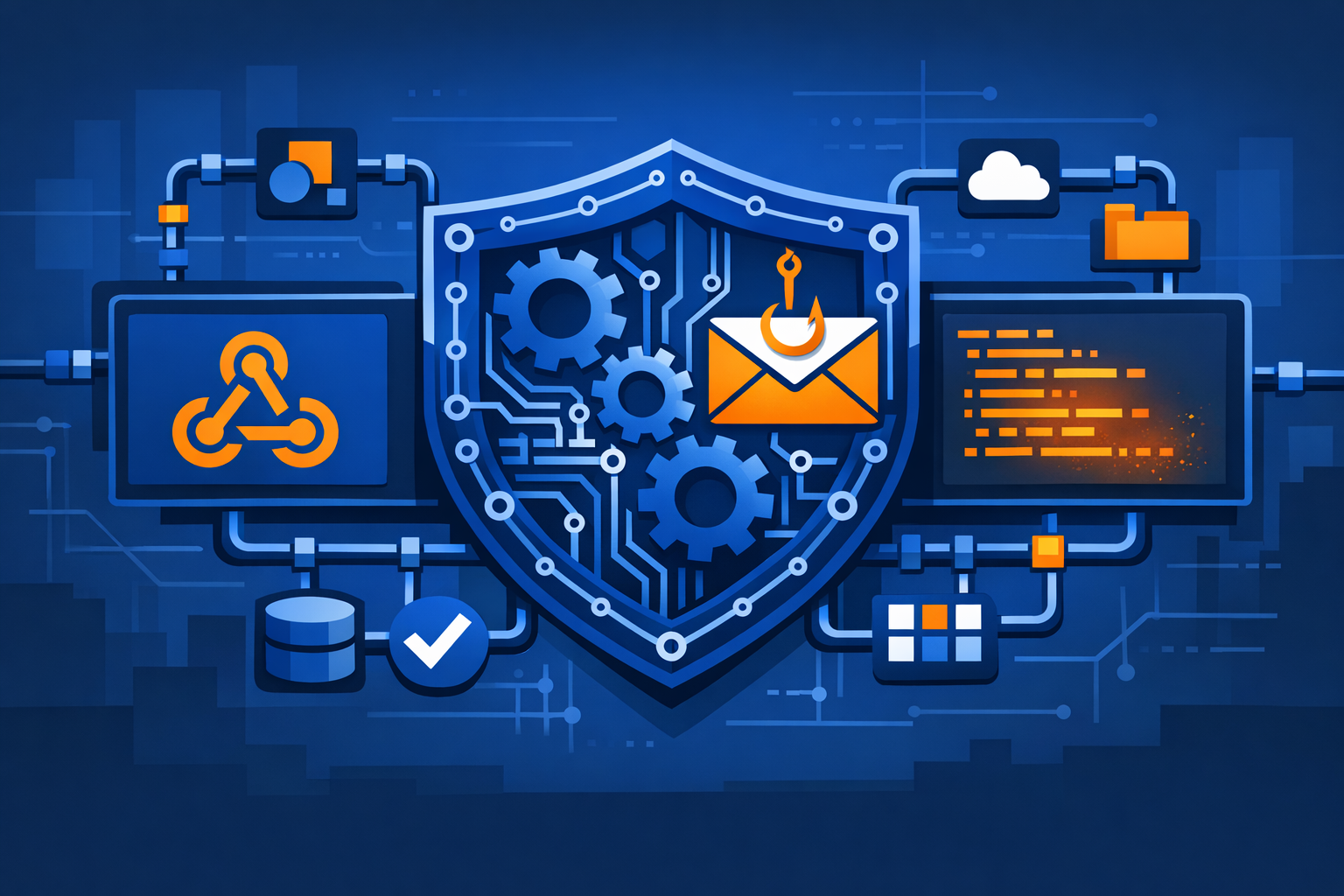
Security researchers have identified an escalating wave of phishing campaigns exploiting legitimate AI-powered workflow automation platforms to deliver malware and steal credentials-a technique that systematically bypasses traditional enterprise defenses. Cisco Talos researchers documented sustained abuse of the n8n AI workflow automation platform, with threat actors using tti.app.n8n.cloud subdomains to send automated phishing emails and deliver malicious payloads. Activity spanned October 2025 through March 2026.
Email volume containing n8n webhook URLs increased by 686% between January 2025 and March 2026, according to Cisco Talos data. The trend has forced security teams to revisit fundamental assumptions about trusted infrastructure and access governance across enterprise automation stacks.
Background
AI workflow automation platforms such as Zapier and n8n connect different software applications-including Slack, Google Sheets, and Gmail-with AI models such as OpenAI's GPT-4 or Anthropic's Claude. Their widespread enterprise adoption has created a new attack surface that threat actors are actively exploiting.
The n8n campaign is the latest example in a broader trend where legitimate productivity and low-code platforms, including Zapier and Softr.io, have been weaponized for phishing and malware delivery. Security teams increasingly face adversaries who abuse third-party SaaS infrastructure to blend malicious activity with benign traffic.
The governance gap underpinning these attacks is significant. According to Teleport's 2026 State of AI in Enterprise Infrastructure Security report, based on surveys of 205 CISOs and security architects, 70% of enterprises already have AI agents running in production, yet 70% of those same organizations report that their AI systems have more access than equivalent human roles. Only 3% having automated machine-speed controls governing AI behavior.
Details
The Cisco Talos investigation outlines two distinct abuse techniques. Webhooks mask the source of the data they deliver, enabling payloads from untrusted sources to appear as though they originate from a trusted domain. Additionally, because webhooks can dynamically serve different data streams based on triggering events, phishing operators can tailor payloads based on the user-agent header.
Observed campaigns used CAPTCHA-protected pages to deliver remote access tools, including modified Datto RMM and ITarian Endpoint Management software, while webhooks masked malicious payload sources behind legitimate n8n domains. Additional abuse cases involved tracking pixels embedded in emails for device fingerprinting.
Separately, Microsoft Defender Security Research observed a widespread phishing campaign leveraging the device code authentication flow to compromise organizational accounts at scale. The campaign achieved a higher success rate through automation and dynamic code generation that circumvented the standard 15-minute expiration window for device codes. Generative AI created targeted phishing emails aligned to the victim's role-including themes such as RFPs, invoices, and manufacturing workflows-increasing the likelihood of user interaction.
Detection is further complicated by infrastructure choices. Researchers observed heavy reliance on Vercel, Cloudflare Workers, and AWS Lambda to host redirect logic, causing phishing traffic to blend with legitimate enterprise cloud traffic and evading simple domain-blocklist triggers.
The supply chain dimension adds another layer of risk. Third-party AI agent products operate on enterprise infrastructure, access corporate data, and authenticate using API keys and credentials. Microsoft's EchoLeak vulnerability (CVE-2025-32711) demonstrated that a third-party AI product can exfiltrate data via a crafted email with no user action required, leaving organizations responsible for governing third-party AI agent access-even when they do not control the underlying model.
In 2025, credential theft remained the most common attack vector in the annual Verizon Data Breach Investigation Report.
Outlook
Security practitioners have identified concrete controls enterprises should implement immediately. If an endpoint attempts to communicate with an AI automation platform domain not part of the organization's authorized workflow, it should trigger an immediate alert. Security teams should enforce least privilege by limiting permissions granted to both human users and AI agents to prevent lateral movement and unauthorized data access.
No official patch addresses this class of threat, as the attacks exploit legitimate platform features rather than software vulnerabilities. Organizations must implement behavioral detection mechanisms to identify suspicious use of automation webhooks; simple domain or URL blocking is insufficient given the use of legitimate platform domains.
Recognizing the scale of the problem, NIST's Center for AI Standards and Innovation launched a formal AI Agent Standards Initiative on February 17, 2026-the first government-level standards effort specifically targeting AI agent security. Enterprises that have not yet audited third-party AI module access, established approved agent registries, and deployed continuous anomaly monitoring across workflow endpoints face growing exposure as threat actors accelerate automation of attack infrastructure.