Security researchers at Cisco Talos have documented a sustained wave of phishing attacks exploiting the AI workflow automation platform n8n, with malicious email volume rising 686% between January 2025 and March 2026 as threat actors repurpose legitimate enterprise tooling to bypass conventional defenses. The campaign, active since at least October 2025, represents a broader shift in attacker tradecraft: hijacking trusted cloud infrastructure to deliver malware and fingerprint targets at scale.
Background
AI workflow automation platforms such as Zapier and n8n connect software applications-including Slack, Google Sheets, and Gmail-with AI models such as OpenAI's GPT-4 or Anthropic's Claude. Their rapid enterprise adoption has expanded the attack surface. Phishing returned as the leading initial-access method in Q1 2026, accounting for over a third of engagements where initial access could be determined, according to Cisco Talos. Separately, Microsoft security researchers observed a significant escalation in threat actor sophistication, with newer campaigns shifting from static, manual scripts toward AI-driven infrastructure and multiple end-to-end automations.
The n8n abuse pattern follows earlier exploitation of Softr, an AI-powered web application builder. One phishing incident in Q1 2026 involved a technique Talos had not previously documented: attackers targeting a public administration organization used Softr to build a credential-harvesting page. The Softr incident marks the first time Talos documented a specific AI tool used in a confirmed phishing engagement.
Attack Mechanics and Incident Patterns
Threat actors have weaponized n8n to facilitate sophisticated phishing campaigns, deliver malicious payloads, and fingerprint devices. Cisco Talos researchers Sean Gallagher and Omid Mirzaei stated that "by leveraging trusted infrastructure, these attackers bypass traditional security filters, turning productivity tools into delivery vehicles for persistent remote access."
The primary attack vector exploits n8n's webhook feature. Because webhooks mask the source of the data they deliver, they can serve payloads from untrusted sources while appearing to originate from a trusted domain. Since webhooks can dynamically serve different data streams based on triggering events such as request header information, a phishing operator can tailor payloads based on the victim's user-agent header.
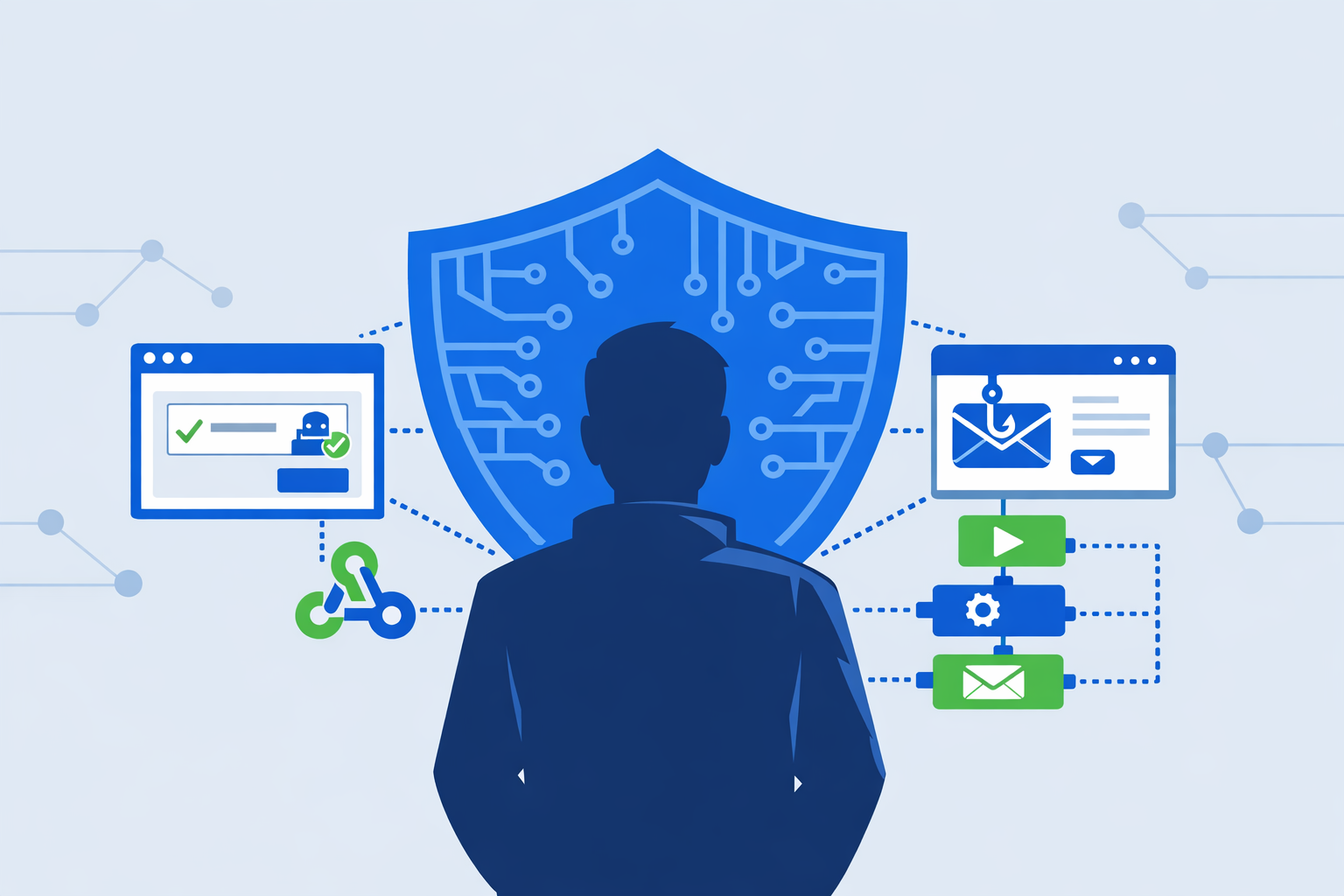
In the most prevalent campaign pattern, threat actors disguised n8n webhook links as shared Microsoft OneDrive folders. When a victim clicked the link, the browser loaded a webpage presenting a CAPTCHA challenge. Solving the CAPTCHA triggered a JavaScript-driven download of an executable file that appeared to originate from the trusted n8n domain.
The end goal is to deliver an executable or MSI installer that serves as a conduit for modified versions of legitimate Remote Monitoring and Management (RMM) tools like Datto and ITarian Endpoint Management, establishing persistence via a command-and-control server connection. In one documented case, the malware executed Python modules to exfiltrate system data while displaying a fake installation progress bar to deceive the user.
Beyond payload delivery, threat actors also leverage n8n webhooks for stealthy device fingerprinting. By embedding invisible tracking pixels in HTML emails, attackers force the victim's email client to send an HTTP GET request to the webhook URL when the message is opened, automatically capturing the victim's IP address, verifying the email account's activity, and gathering target telemetry without requiring any direct interaction.
Separately, Microsoft's Defender Security Research team documented a parallel escalation: threat actors used automation platforms such as Railway.com to spin up thousands of unique, short-lived polling nodes, deploying complex backend logic in Node.js that bypassed traditional signature-based or pattern-based detection. Generative AI created targeted phishing emails aligned to the victim's role-including themes such as RFPs, invoices, and manufacturing workflows-increasing the likelihood of user interaction.
Defensive Outlook
Because workflow automation platforms are inherently flexible and highly interconnected, defending against this abuse requires more than simple static analysis. Security teams cannot rely on blanket domain blocking; denylisting domains like n8n's cloud infrastructure would severely disrupt legitimate business operations.
Cisco Talos recommends that organizations adopt behavior-based detection methodologies. Practical mitigations include tightening registration controls, enforcing multi-factor authentication (MFA) and billing validation, blocking or scrutinizing third-party subdomains in high-risk contexts, and integrating webhook behavior into data loss prevention and email-gateway policies. Defenders should monitor for unusual account provisioning, spikes in outbound email activity from workflow subdomains, and redirects hosted on automation platform domains. Vendors and enterprises should expect additional disclosures and possible mitigations from n8n; defenders should update detection rules and threat-hunting playbooks to include workflow automation telemetry.
MFA weaknesses appeared in 35% of Talos-investigated engagements in Q1 2026, with attackers bypassing MFA by registering new devices to compromised accounts or configuring email clients to connect directly to Exchange servers, sidestepping MFA requirements entirely. Security teams are advised to treat all third-party workflow automation endpoints as potentially risky infrastructure and review existing allowlists accordingly.