Enterprise automation is shifting from isolated RPA (robotic process automation) bots and workflow scripts to integrated automation platforms positioned alongside ERP (enterprise resource planning), CRM (customer relationship management), and security systems. This platformification trend is transforming vendor ecosystems, governance approaches, and ROI benchmarks as organizations scale AI-enabled automation across business functions.
Senior IT and business leaders now face a strategically different decision: selecting an automation platform to orchestrate end-to-end, multi-step workflows, rather than deploying individual tools for discrete processes.
Defining Platformification in Enterprise Automation
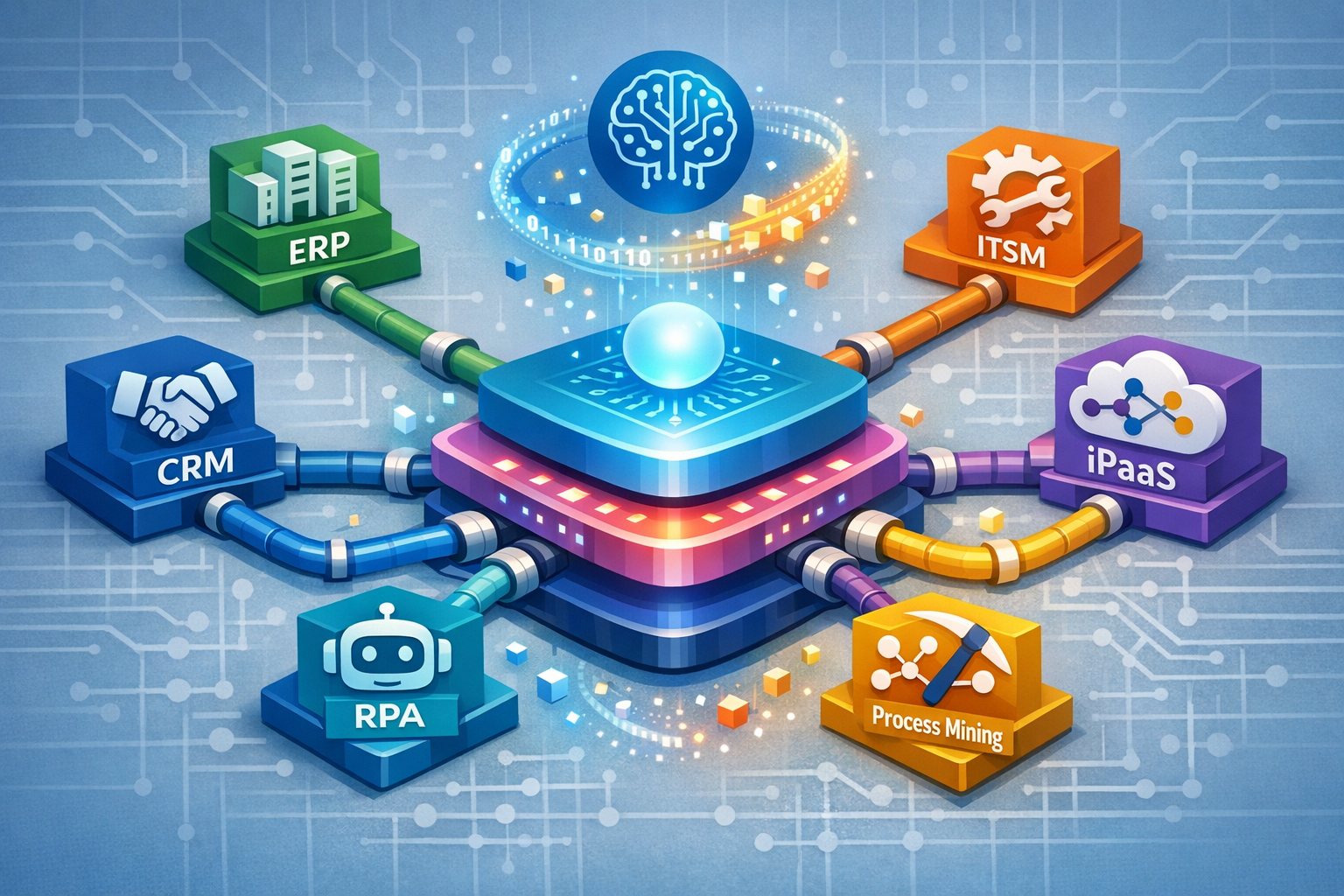
Platformification refers to the consolidation of traditionally separate automation tools-RPA, workflow/BPM (business process management), ITSM (IT service management) add-ons, integration brokers, process mining, and intelligent document processing (IDP)-into unified automation platforms.
Instead of deploying different products for tasks in finance, IT operations, or document capture, enterprises increasingly seek platforms offering:
- A common orchestration layer for workflows across applications and data sources
- Built-in integration including APIs, iPaaS (integration platform as a service) connectors, and event streams
- Policy-based governance, access control, and audit trails
- Low-code tooling for both professional and citizen developers
- Native AI capabilities such as large language models (LLMs), IDP, recommendations, and agents
Major vendors illustrate this trend: RPA providers like UiPath are bundling process mining, communications mining, and document understanding into comprehensive business automation platforms. Microsoft integrates Power Automate and process mining as hyperautomation components within its Power Platform.[1] Similarly, IDP vendors such as Tungsten Automation combine IDP, orchestration, RPA, and analytics into unified offerings for end-to-end document workflows.[2]
This convergence is shifting architectural focus from a proliferation of point solutions to a small number of strategic automation platforms.
Market Signals: From RPA and Workflow Tools to Automation Platforms
Adjacent automation markets-including RPA, workflow automation, and integration platforms-are all experiencing robust growth, with a shift toward cloud-based, platform-oriented solutions.
Analyst estimates project the global workflow automation market to reach $11.5 billion in 2026 and $36.7 billion by 2035, a CAGR of 13.4%.[3] Software represents about two-thirds of this spend, while services account for the rest.[3]
The global RPA software market reached approximately $4.3 billion in 2023, with forecasts of $38.3 billion by 2032 and a CAGR of 27.5%.[4]
The iPaaS market grew from $5.2 billion in 2023 to $6.7 billion in 2024, with expectations to exceed $61-64 billion by 2032.[5]
These markets increasingly intersect. Hyperautomation and automation fabric strategies combine them-leveraging iPaaS as the connective layer between RPA, workflow engines, AI services, and business systems.
Comparative View of Key Automation-Adjacent Markets
| Segment | Baseline Market Size (Year) | Projected Size (Horizon) | Indicative CAGR | Notable Trend |
|---|---|---|---|---|
| RPA software | ~$4.3B (2023) | ~$38.3B (2032) | ~27.5% (2024-2032) | RPA suites expanding into full automation platforms |
| Workflow automation | ~$11.5B (2026) | ~$36.7B (2035) | ~13.4% (2026-2035) | AI-infused workflows; most deployments cloud-based |
| Integration Platform as a Service (iPaaS) | ~$5.2B (2023); $6.7B (2024) | >$61-64B (2032) | ~33% (2026-2035) | Cloud-native integration supporting cross-platform automation |
Sources: IndustryResearch, MarketBusinessInsights, and other market studies.[3]
On the demand side, projections for adoption and operating-model change reinforce the platform focus:
- By 2026, Gartner expects ~30% of enterprises to automate over half their network and operations activities, compared to under 10% in mid-2023.[6]
- IDC cites that about 60% of large enterprises will adopt unified automation platforms for centralized control by 2026.[6]
- Gartner also forecasts that by 2026, over 80% of enterprises will use generative AI APIs or GenAI-enabled applications, versus less than 5% in 2023.[6]
These projections are contingent on the ability to coordinate automation at scale, which generally requires a platform-centric architecture rather than collections of task-oriented tools.
Analysts further note a consolidation in the market. Forrester observes that digital process automation (DPA) specialists are under pressure from low-code platforms, expanded RPA suites, and large enterprise vendors embedding automation into ERP and CRM portfolios.[7] This is resulting in movement toward multi-capability platforms and diminishing the role of standalone workflow tools.
Why Platforms Win: Capabilities CIOs Now Expect
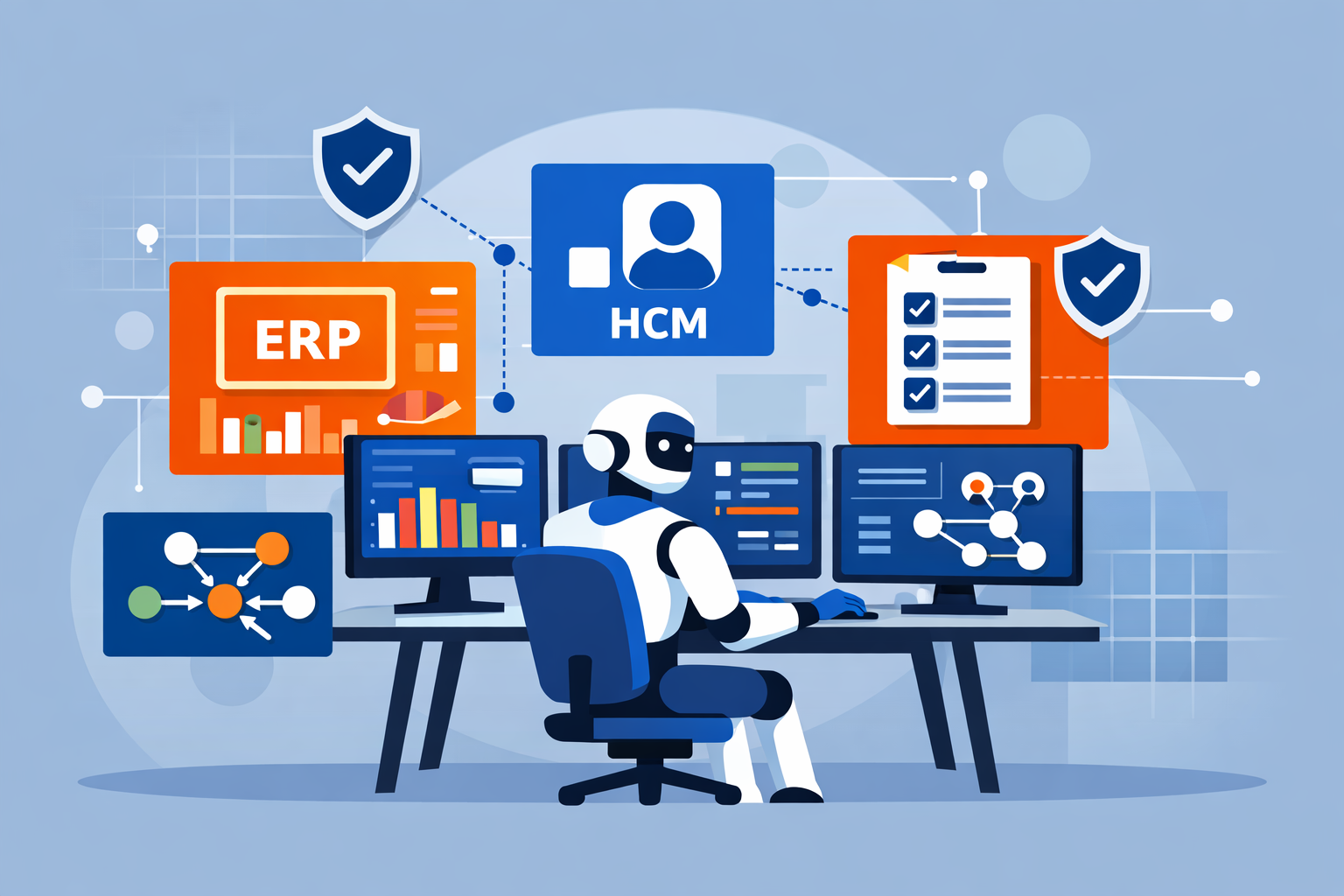
End-to-End Orchestration Across ERP, CRM, and Custom Apps
Enterprise automation frequently spans systems. High-value workflows include lead-to-cash across CRM, CPQ, ERP, billing, and data warehouse, or procure-to-pay across ERP, supplier portals, IDP, and approval chains.
Automation platforms address these needs with:
- Cross-application orchestration engines to call APIs, trigger RPA bots, and respond to events
- Deep connectors to SaaS and on-premise systems through iPaaS channels[8]
- Process and task mining tools to identify automation opportunities and optimize flows[9]
Vendor roadmaps reflect this orchestration priority. Microsoft presents its process mining and automation tools as part of a hyperautomation suite for multi-step workflow creation with integrated analytics and GenAI support via Copilot.[10] UiPath merges process, task, and communications mining with RPA and IDP in a single platform, highlighting continuous discovery and orchestrated execution.[1]
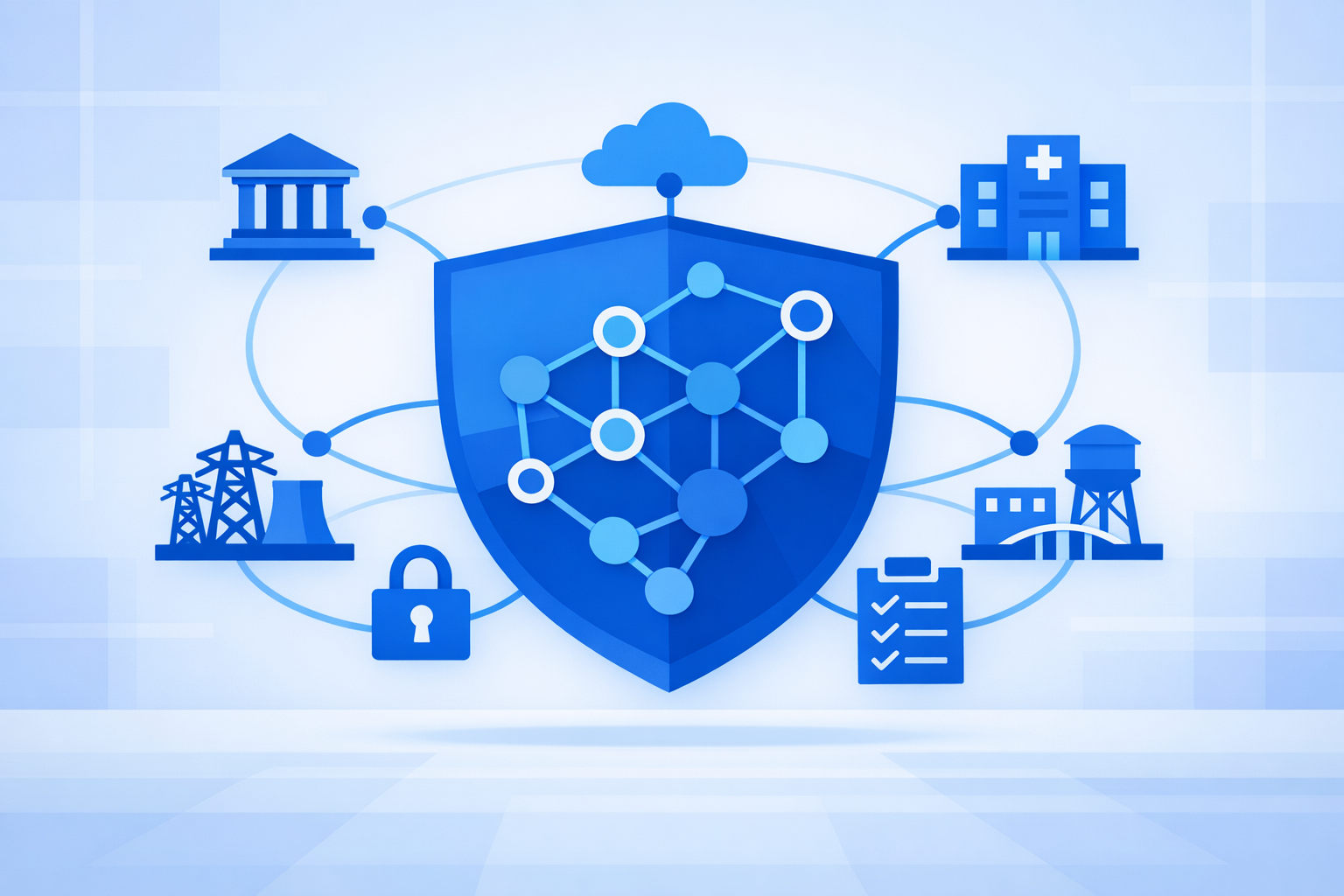
Unified Governance, Security, and Compliance
With automation extending across multiple functions and locations, governance challenges escalate. Fragmented tools make it difficult to track automations, manage user access, or audit AI-driven decisions.
Platforms respond with:
- Policy-based access controls, approval flows, and segregation of duties
- Centralized registries for automation artifacts and versions
- Standardized logging, audit trails, and data lineage
- Configuration management for data residency and sovereignty
Workflow automation studies report that integration complexity, skills shortages, and regulatory issues are cited by 22-35% of organizations as key obstacles to automation scale-up.[3] CIOs and CISOs typically prefer platforms offering improved control over a multitude of loosely managed tools. Regulatory pressure in financial and critical sectors further encourages platform consolidation to ensure auditability and compliance.
AI-Native and Low-Code by Design
AI is now integral to enterprise automation. Platforms increasingly embed LLMs, classifiers, and recommendation engines into workflow creation and execution.
In workflow automation, about 55% of vendors offer AI integration and 63% of deployments are cloud-based.[3] Low-code and no-code capabilities are also widespread, with approximately 39% of offerings focused on low-code tooling to support both IT and business roles.[3]
Academic and industry research indicates that integrating RPA with foundation models reduces setup time and maintenance for complex, variable workflows, especially those using unstructured data.[11] Platforms that treat AI as an embedded, first-class element-enabling orchestration, validation, and exception handling-are therefore in increasing demand.
Impact on ROI, TCO, and Operating Models
Changing ROI Benchmarks
Total Economic Impact studies and industry benchmarks suggest that robust automation programs can achieve substantial returns:
Recent Forrester TEI analyses estimate three-year ROI of about 248% for low-code workflow plus RPA platforms and up to 330% for intelligent automation suites, with payback typically under six months.[12]
However, ROI varies. Organizations that approach automation as a platform strategy outperform those accumulating separate tools. Success factors include:
- Breadth of adoption (critical processes transitioned to the platform)
- Retirement of legacy scripts to realize consolidation benefits
- Consistent governance, oversight, and optimization
ROI evaluation is increasingly platform-centric, using metrics such as use cases per platform, automations per employee, and deployment or modification speed to assess value.
Total Cost of Ownership and Tool Consolidation
Platformification lowers total cost of ownership through:
- Licensing and vendor management: reduced contracts, consolidated pricing, and standard terms
- Infrastructure: cloud-based platforms and iPaaS minimize bespoke middleware and on-premise servers
- Operations: unified updates, pattern libraries, and reusable components cut support costs
Actual savings depend on retiring legacy tools. Without doing so, platforms may increase, not decrease, overall spending.
Operating-Model Implications
Enterprises are adopting federated automation models featuring:
- Central teams setting standards, governance, and architecture
- Domain teams (finance, supply chain, IT, operations) managing use-case pipeline and delivery
- Shared enablement for citizen developers, with appropriate guardrails
Analyst guidance indicates that effective automation programs blend centralized oversight with distributed innovation, relying on common platforms.[7]
Sector Lens: Financial Services, Manufacturing, and Logistics
Platform-based automation adoption rates vary by industry. Data points to financial services, manufacturing, and logistics as leading sectors.
Financial Services (BFSI)
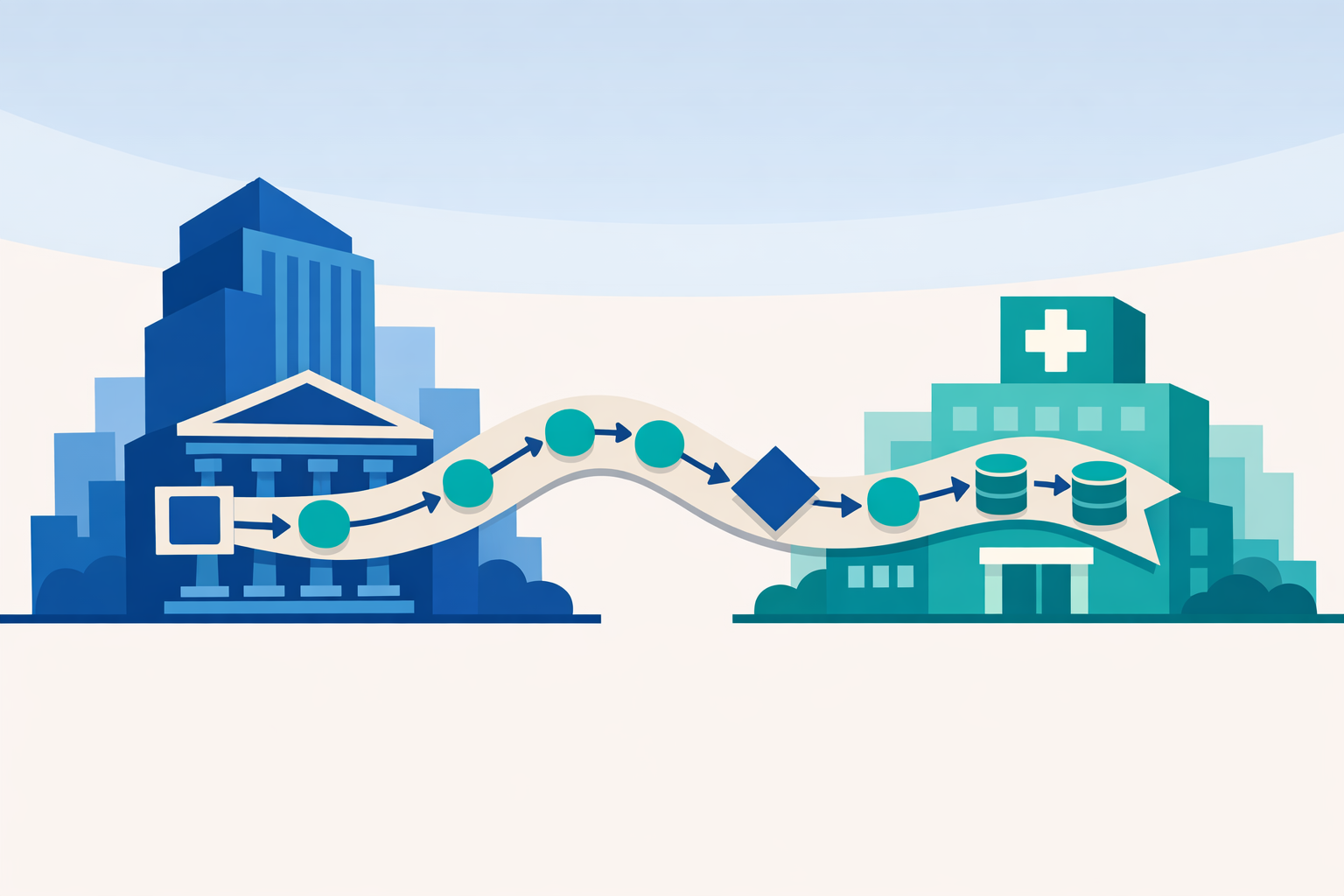
Banking, financial services, and insurance (BFSI) represent approximately 36-40% of global RPA revenue-the largest sector share.[13] BFSI also leads workflow automation, holding 24% of the segment.[3]
Key drivers:
- High volumes of repeatable, rules-driven transactions (e.g., KYC, onboarding, payments)
- Strong regulatory and audit obligations requiring standardized governance
- Clear business cases for operational risk and cycle time reduction
Financial institutions are early adopters of unified platforms combining process mining, IDP, RPA, and rules engines for monitoring and reporting functions.
Manufacturing and Industrial Supply Chains
Manufacturing and healthcare together account for about 35% of RPA market share, reflecting increased automation in production, quality assurance, and patient-data management.[14] Logistics and manufacturing firms are automating invoice processing and inventory with reported error reductions above 90% in some cases.[15]
Here, platforms enable:
- Plant, warehouse, and transport orchestration across ERP, MES (manufacturing execution systems), WMS (warehouse management systems), and TMS (transportation management systems)
- OT (operational technology) and IT convergence via event-driven automation and IoT integration
- Use of AI agents for scheduling, anomaly detection, and exception handling
Cross-Industry Observations
Large enterprises account for more than 65% of workflow automation spend and are the primary platform adopters.[3] North America and Western Europe lead in adoption rates, with Asia-Pacific the fastest-growing region for workflow automation and iPaaS.
Frequently Asked Questions
How is an enterprise automation platform different from RPA or basic workflow tools?
RPA tools automate specific user interface or API tasks, and basic workflow applications manage approvals or tasks within a single function. In contrast, enterprise automation platforms unify RPA, orchestration, process mining, IDP, iPaaS-level integration, and analytics within a single governance layer, allowing cross-system, end-to-end process automation with centralized management.
What metrics should senior leaders use to evaluate automation platforms?
Traditional counts of bots or scripts have limited relevance at platform scale. More useful metrics include:
- Number of high-value processes automated on the platform
- Time to design, deploy, and change workflows
- Automation coverage of transactions or cases
- Reduction in errors and rework
- Platform adoption across departments and regions
Strategic KPIs such as cycle time improvements and compliance impact are also important.
Does migrating to a single automation platform increase vendor lock-in risk?
Consolidation increases reliance on fewer vendors, introducing potential lock-in unless portability and interoperability are addressed.
Mitigation includes selecting platforms with:
- Open, well-documented APIs and event hooks
- Support for open standards in data and identity
- Export and migration options for workflows
- Integration across multiple clouds and security infrastructures
Contract provisions for exit and data portability should be considered for major agreements.
How should automation platforms connect with ERP, CRM, and security?
Typically, automation platforms sit as a horizontal layer above core systems rather than replacing them. Best practices include:
- Certified connectors and iPaaS integration with ERP, CRM, HR, and custom applications
- Leveraging existing IAM and SSO security infrastructure
- Aligning observability and SIEM integration with enterprise monitoring stacks
- Consistent data classification and retention across workflows and core systems
This supports automation of business processes while maintaining security and compliance standards.
What organizational changes support platform-based automation?
Effective adoption involves:
- Establishing an automation or digital operations program with cross-functional leadership
- Defining process ownership shared by IT and business functions
- Setting guardrails for citizen development
- Investing in skills for both platform engineering and process analysis
Treating platformification as an operating model shift, not just a technology update, leads to better outcomes.
Conclusion and Next Steps for Automation Strategy
Platformification is transforming enterprise automation from collections of departmental tools into strategic layers spanning applications, data, and AI services. Growth in RPA, workflow automation, and iPaaS, together with forecasts for widespread hyperautomation and GenAI adoption by 2026, indicate a clear trajectory for the industry.
Key priorities for CIOs, CTOs, and architecture leaders over the 2026-2028 horizon include:
- Define a reference architecture mapping automation platforms' interfaces with ERP, CRM, data, and security stacks via APIs and events.
- Rationalize automation tooling, identifying and consolidating legacy scripts, macros, and niche solutions onto strategic platforms where feasible.
- Select platforms on multidimensional criteria-governance, AI, integration, ecosystem, and openness-instead of focusing on feature checklists.
- Design an operating model balancing centralized oversight with federated, domain-driven innovation.
- Align automation governance with regulation, ensuring auditability, data lineage, and incident management are integral to the platform.
Enterprises that conduct platformification as a deliberate architectural and governance transformation are better positioned to achieve sustainable gains in efficiency, resilience, and innovation through automation.