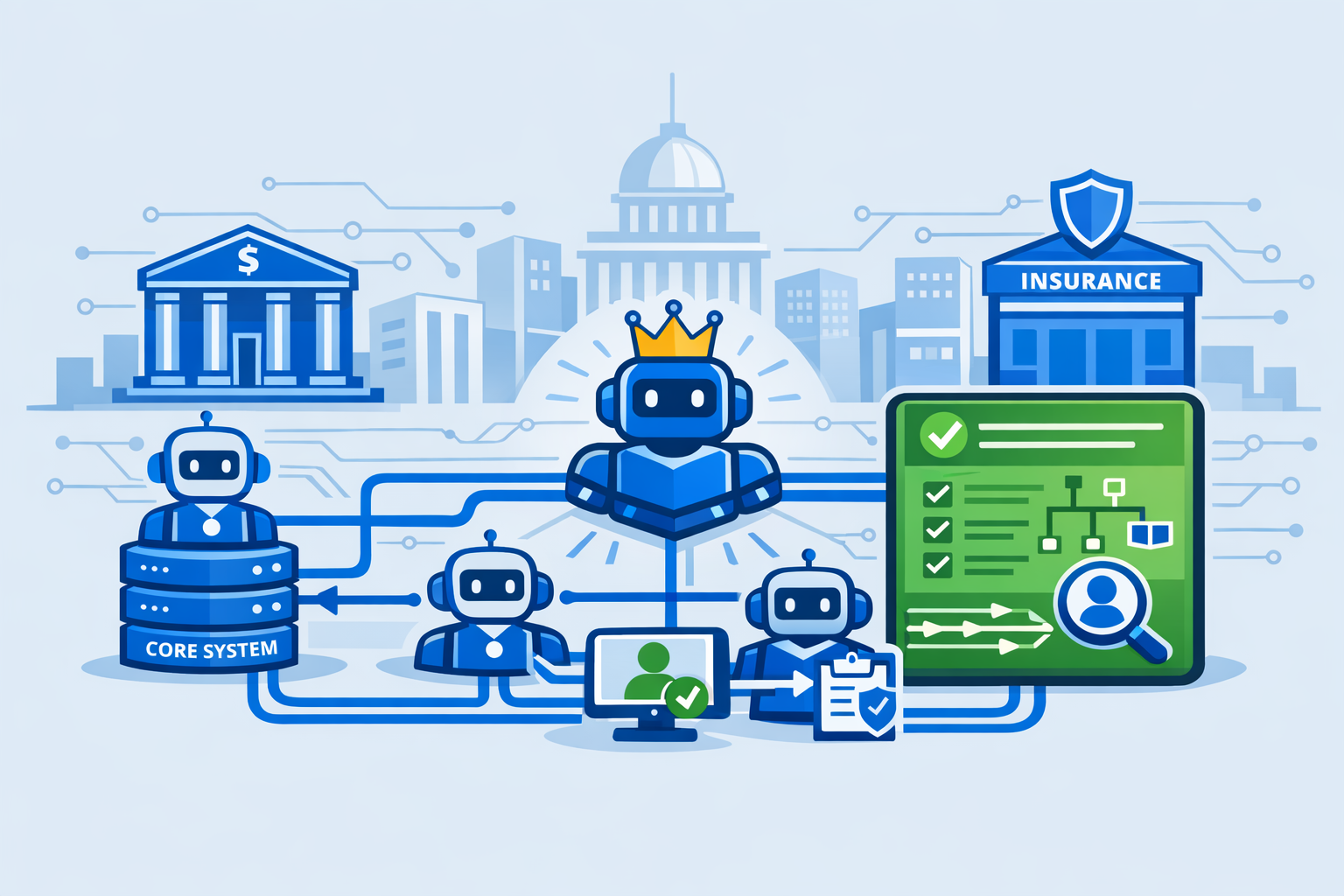
Executive summary. US federal and state regulators are expanding AI oversight in banking and insurance from individual models to end-to-end workflows executed by AI agents. As frameworks like NIST's AI Risk Management Framework (AI RMF) and the US Treasury's Financial Services AI Risk Management Framework (FS AI RMF) are adopted, regulatory expectations are converging around interoperable data schemas, standardized agent metadata, and auditable workflow controls. The regulatory direction is increasingly clear: AI workflow agents must function within governed, interoperable environments that maintain human oversight and enforce risk boundaries.
Regulators Shift from Model Risk to Workflow Agent Interoperability
Initially, US financial sector AI regulation addressed model risk and consumer protection, treating machine learning as an extension of traditional statistical models. The scope now includes autonomous and semi-autonomous workflow agents that coordinate decisions across systems and organizations.
On January 26, 2023, the National Institute of Standards and Technology (NIST) released AI RMF 1.0 as a voluntary, cross-sector Artificial Intelligence Risk Management Framework.[1] The framework defines four functions-GOVERN, MAP, MEASURE, MANAGE-used by many financial institutions to document AI risks.
In February 2026, the US Department of the Treasury published the Financial Services AI Risk Management Framework (FS AI RMF) and an AI Lexicon, adapting NIST's AI RMF for financial services.[2] Treasury's materials prioritize consistent terminology, lifecycle risk management, and integration with supervisory expectations, such as model risk management guidance (e.g., SR 11-7) and consumer-protection rules.[3]
State-level insurance supervision is advancing quickly.
The National Association of Insurance Commissioners (NAIC) adopted its Artificial Intelligence Model Bulletin in December 2023, providing a uniform framework for evaluating insurers' use of AI and big data, including governance, data controls, and oversight of third-party AI systems.[4] The bulletin requires insurers to inventory AI systems, document roles and responsibilities, and demonstrate data lineage and protection measures.
Colorado's Regulation 10-1-1, effective November 14, 2023, is the first binding state regulation requiring life insurers using external consumer data, algorithms, and predictive models to implement formal governance and risk management, including documented model inventories and ongoing monitoring.[5] This regulation promotes interoperability by requiring insurers to explain how algorithms interact with data sources and downstream processes.
Requirements for human oversight are also increasing.
Florida's House Bill 527 (Mandatory Human Reviews of Insurance Claim Denials), advancing through the legislature in early 2026, would prohibit property and health insurers from denying or reducing a claim based solely on AI, machine learning, or algorithmic outputs and require a qualified human to make the final decision with supporting documentation.[6] Similar provisions have appeared in previous Senate analyses and related proposals.[7]
Regulatory signals indicate that state-level AI and data-protection statutes for lending, employment, and consumer rights will extend to AI-driven decisions in banking and insurance, tightening expectations around explainability, bias controls, and data governance for AI workflows.[8]
Key regulatory instruments shaping AI workflow agents
| Instrument / jurisdiction | Primary AI focus in financial services | Implications for workflow agents |
|---|---|---|
| NIST AI RMF 1.0 (US, cross-sector) | Voluntary, risk-based framework (GOVERN/MAP/MEASURE/MANAGE) for trustworthy AI across the lifecycle. | Encourages institutions to treat agentic workflows as AI "systems" requiring risk identification, measurement, and controls, beyond model tuning.[1] |
| US Treasury FS AI RMF (2026) | Sector-specific adaptation of NIST AI RMF plus shared AI Lexicon for financial services. | Pushes banks and insurers toward consistent categorization of AI use cases, including agents, and governance alignment with prudential and consumer-protection rules.[2] |
| NAIC AI Model Bulletin (2023) | Requirements for insurers' AI governance, including data management, third-party oversight, and documentation. | Mandates inventories and governance structures for AI agents in underwriting, pricing, and claims workflows.[4] |
| Colorado Regulation 10-1-1 (2023) | Governance and risk management for life insurers using external consumer data and algorithms. | Requires detailed mapping of data sources, models, and decisions-key for interoperable, auditable agent workflows.[5] |
| Florida HB 527 (pending, 2026) | Human-in-the-loop requirements for AI-assisted claims handling. | Establishes human oversight and record-keeping for AI-influenced decisions, limiting how much agents adjudicate claims autonomously.[6] |
| State AI / data-driven lending laws (various) | Bias, transparency, and data-use rules for AI in credit and employment. | Expands interoperability needs in workflows like credit underwriting and fraud detection, where agents use shared data and third-party scores.[8] |
Together, these measures drive banks and insurers toward standardized AI system descriptions, improved data governance, and verifiable human oversight-foundations for rigorous interoperability standards for AI workflow agents.
Why Interoperability of AI Workflow Agents Has Become a Supervisory Priority
AI workflow agents operate across multiple systems, executing orchestrated tasks such as know-your-customer (KYC) checks, underwriting, fraud investigations, and claims triage.
Insurance case studies show that multi-step agentic workflows can reduce onboarding time and improve accuracy when integrated with CRM and legacy policy systems, while maintaining audit trails.[9] These gains drive interest in agentic automation.
However, interoperability gaps have emerged as systemic risk areas:
- Fragmented APIs and data models. A 2026 review of financial APIs identified more than 80 frameworks in use across banks and fintechs in a single jurisdiction, lacking schema or authentication convergence.[10] This complicates controls for agents operating across institutions.
- Opaque cross-vendor agent communications. Open standards such as Agent2Agent (A2A) are normalizing agent discovery and messaging across vendors and runtimes. By mid-2025, the Linux Foundation's A2A project reported backing from over 100 firms as an open protocol for secure agent-to-agent communication.[11] Regulators are monitoring such protocol adoption.
- Limited governance maturity. A 2024 benchmarking survey of more than 200 financial sector compliance leaders found that only 32% had an AI governance committee, and just 12% applied a formal AI risk management framework, despite widespread AI tool deployment.[12] This governance lag is more acute as AI agents manage full workflows.
Regulators are less concerned with individual model intelligence and increasingly focused on cumulative risk from agents chaining actions-API calls, data enrichment, routing, and automated decisions-without clear, interoperable controls. Supervisors now routinely ask:
- Which agents handled specific data, in what sequence, and under which policies?
- Are agent permissions and capabilities specified in standardized, machine-readable, auditable formats?
- How is human oversight enforced when decisions cross organizational boundaries (e.g., bank-insurer partnerships, correspondent banking, reinsurance chains)?
These questions link interoperability standards with regulatory priorities: consistent data governance, explainability, and operational resilience.
Emerging Building Blocks of an Interoperability Standard
No unified or binding interoperability standard for AI workflow agents exists yet in US financial services, but several technical and governance elements are becoming common.
Standardized agent metadata and packaging
New open specifications are defining how to represent AI agents in portable, auditable formats:
- Agent manifests and identity. Initiatives like Manifest YAML specify agent identity, permissions, behavior, and trust attributes in machine-readable files, with public registry APIs for discovery.[13]
- Agent packaging standards. The Agent Packaging Standard (APS) outlines a vendor-neutral package format, including an
agent.yamlmanifest and registry API, supporting signing and provenance.[14]
Regulatory evaluation of interoperability will likely prefer:
- Machine-readable metadata describing an agent's functions, inputs/outputs, autonomy, and controls.
- Registry-based discovery and attestation, ensuring only approved agents function in critical workflows.
Data provenance, lineage, and evidentiary controls
Research and policy efforts are bringing data governance into AI assurance:
- AI risk-assurance models propose bills of materials and machine-readable records of data sources, security testing, and controls.[15]
- "Policy Card" models encode allow/deny rules, obligations, and links to frameworks like NIST AI RMF and ISO/IEC 42001.[16]
NAIC guidance and state regulation already require documentation of data lineage, quality controls, and ongoing model monitoring for third-party AI systems.[4] Applying these requirements to agents means:
- Traceable end-to-end lineage from source data through agentic transformations to outcomes.
- Tamper-evident logs and artifacts that support audits even for non-deterministic models.
Workflow mapping and risk-appetite alignment
Regulators emphasize that institutions must identify where AI sits in business processes and how that fits risk appetite:
- Treasury's FS AI RMF recommends mapping AI use cases to business and regulatory requirements, then rating criticality and risk.[2]
- Colorado Regulation 10-1-1 mandates inventories documenting algorithmic impact on consumer outcomes.[5]
For workflow agents, this requires:
- Tiered agent risk classifications (informational, decision-support, decision-making) with corresponding controls.
- Confirmation that autonomy, escalation thresholds, and fallbacks are set to risk appetite, particularly in underwriting, fraud, and claims.
Toward interoperable registries and supervisory tooling
Globally, some financial-inclusion bodies are piloting registry systems-using centralized records and analytics pipelines for RegTech supervision of distributed agent networks.[17] The architecture parallels emerging AI agent systems.
Private-sector efforts are developing decentralized registries for autonomous agents, featuring on-chain discovery, usage tracking, and trust scoring.[18] Regulators will likely consider interfaces between supervisory technology and such registries to enable real-time agent oversight.
Operational and Architectural Impacts for Banks and Insurers
Interoperability expectations are shaping technology strategies in banking and insurance.
Architecture, integration, and vendor strategy
Institutions with fragmented AI adoption face:
- Heterogeneous interfaces. Vendors provide different APIs, events, and logging formats, hindering unified oversight of agents across banking, CRM, and policy systems.
- Vendor lock-in vs. open protocols. Initiatives like A2A, Model Context Protocol (MCP), and open manifest/package standards offer alternatives to proprietary orchestration but require thorough security and compliance review.[11]
- Legacy systems. Core platforms often lack machine-readable agent metadata or provenance, necessitating middleware for log normalization and enrichment.
Banks and insurers modernizing AI in banking or AI in insurance should prioritize:
- Contracts requiring standards-based agent metadata and registry access.
- Assessment of vendor support for open interoperability standards versus reliance on proprietary frameworks.
Governance, controls, and assurance
As workflow agents expand in scope, risk and compliance reviews must progress beyond individual models:
- System-level assurance. Regulators may require evidence that full workflows-including policies, routing, approvals, and message flows-operate within controlled parameters.
- Unified data governance. Data quality, lineage, and access must be consistent across internal and partner systems, supporting data-governance mandates.
- Human oversight policies. Measures like Florida's claims-handling standards illustrate moves to establish minimum human-in-the-loop requirements for decisions affecting consumers.[6]
Organizations demonstrating standardized, interoperable agent controls can expect more efficient supervisory reviews and lower remediation costs.
Actionable Steps for CIOs, CTOs, and Risk Leaders
With regulatory expectations evolving, several steps are recommended for institutions deploying AI workflow agents.
1. Establish an agent-centric inventory and classification
- Create a central inventory of all AI workflow agents and automation components, both internal and third-party.
- Classify agents by:
- Business process (e.g., credit underwriting, claims, KYC, fraud).
- Criticality and consumer impact.
- Autonomy (assistive, decision-support, decision-making).
- Link each agent to relevant regulatory frameworks (NIST AI RMF, FS AI RMF, NAIC, and state laws).
2. Map end-to-end workflows and control points
- Document complete workflows involving agents, covering upstream data and downstream processes.
- Identify critical controls, including:
- Data quality and lineage requirements.
- Human approvals for high-impact actions.
- Obligations from data sharing and open APIs.
3. Align AI governance with NIST and Treasury frameworks
- Use NIST AI RMF and FS AI RMF to benchmark governance across GOVERN, MAP, MEASURE, and MANAGE functions.
- Integrate AI workflow governance with model risk, operational risk, and data governance efforts.
- Target governance gaps affecting high-risk agents first.
4. Adopt or pilot standardized agent metadata and packaging
- Require all agents to use machine-readable manifests matching emerging standards.
- Evaluate open packaging specifications (e.g., APS) to reduce integration friction and support registry plans.[14]
- Ensure logging and monitoring allow audit teams to reconstruct agent behavior from standardized records.
5. Prepare for registry and interoperability requirements
- Build internal agent registries cataloging approved agents, risk classifications, and permissions.
- Enable metadata and evidence exposure through secure APIs, with future external registry connectivity in mind.
6. Strengthen cross-functional oversight
- Formalize AI governance committees including technology, risk, compliance, legal, and business, addressing current gaps in structures.[12]
- Define decision rights for agent approval, changes in autonomy, and integration with critical systems.
Proactive steps can minimize future compliance costs and strengthen automated workflow resilience and transparency.
Frequently Asked Questions
How do interoperability standards for AI workflow agents differ from traditional model risk guidance?
Traditional model risk guidance (e.g., SR 11-7) emphasizes development, validation, and use of individual models.[3] Interoperability standards expand this to the full chain of actions and systems where agents operate, including:
- Agent API interactions across internal and external systems.
- Alignment of data schemas and identifiers across organizations.
- Consistent enforcement of permissions, oversight, and audit trails, regardless of vendor.
Model risk management remains critical but must be complemented by cross-system behavior and control standards.
Which regulatory frameworks should banks and insurers prioritize when designing AI agent architectures?
Key frameworks include:
- NIST AI RMF 1.0 for baseline AI risk management.
- Treasury's FS AI RMF and AI Lexicon for sector-specific guidance aligned with NIST and supervisory standards.
- NAIC AI Model Bulletin and state rules such as Colorado Regulation 10-1-1 for insurers, and Florida's HB 527 for claims handling.[2]
Architecture choices for AI workflow agents should demonstrate alignment with these frameworks, focusing on governance, data controls, human oversight, and documentation.
How will tighter interoperability expectations affect vendor lock-in for AI platforms?
Interoperability standards can lower vendor lock-in by promoting standardized agent descriptions and communication protocols, simplifying platform migration or coexistence. Initiatives like A2A, MCP, and agent-packaging standards reflect this direction.[11]
However, lock-in risks remain if standards are implemented in vendor-specific ways or through proprietary extensions. Procurement and architecture teams should:
- Assess adherence to open specifications.
- Avoid proprietary features limiting agent portability.
- Require contractual guarantees for interoperability and data portability.
What role will human oversight play in future standards for AI workflow agents?
Legislation and guidance indicate mandatory human oversight for high-stakes decisions. Florida's HB 527, for example, bans claim denials based solely on AI output and mandates qualified human review and documentation.[6]
Future standards are likely to codify:
- Machine-readable markers for human sign-off within workflows.
- Escalation and fallback logic when ambiguity arises.
- Requirements to document that human reviews occurred.
How should institutions balance agility in AI deployment with growing interoperability and governance requirements?
Early adopters demonstrate that agility and governance are compatible when AI workflow agents are built using modular, standards-aligned architectures. Investments in:
- Centralized agent registries and manifests.
- Standardized logging and data provenance.
- Cross-functional governance committees.
enhance scalability and regulatory adaptability. Reliance on bespoke, non-interoperable agents increases long-term compliance and integration costs as standards evolve.