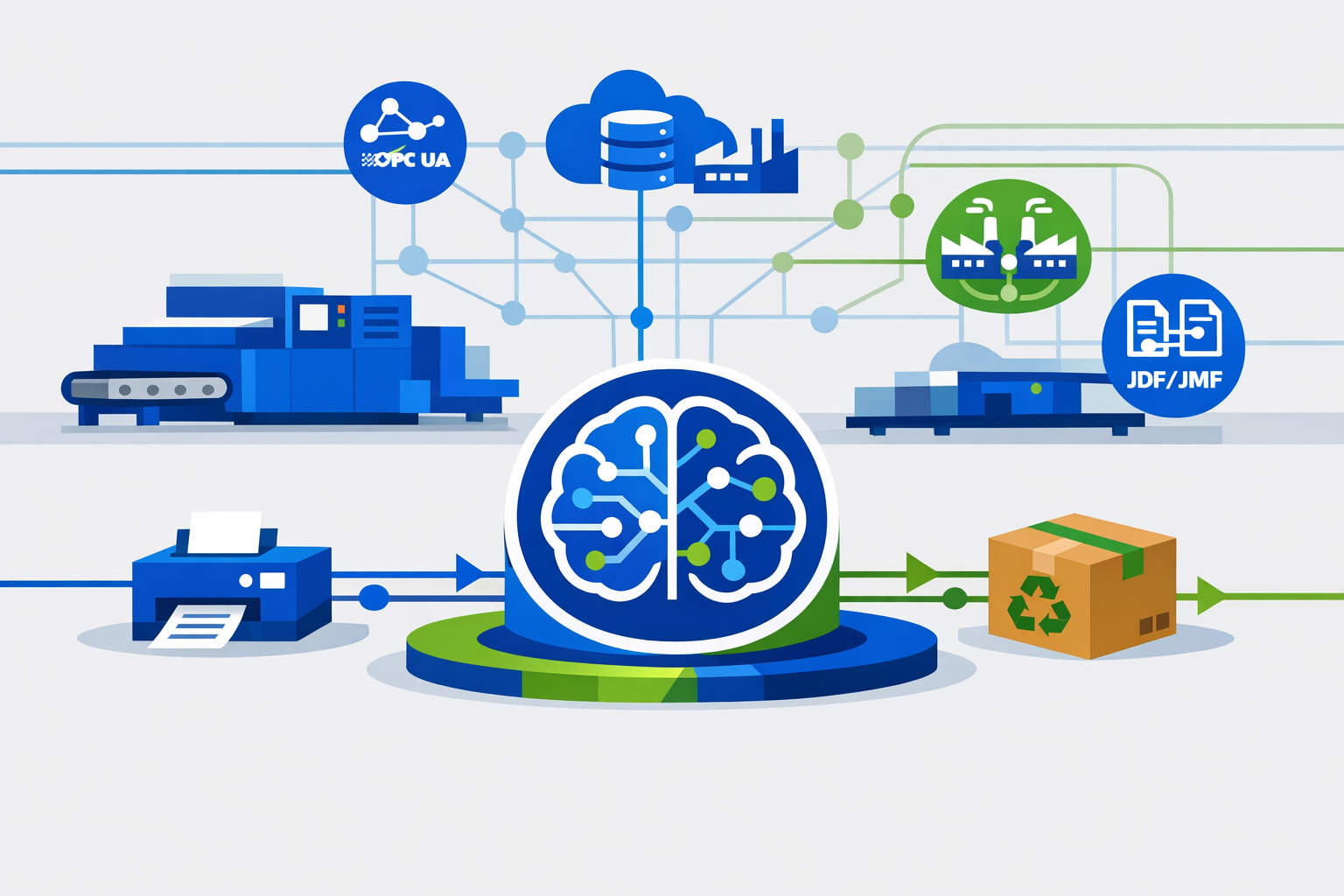
AI-driven automation is transforming B2B print and packaging workflows, enhancing system interoperability, production efficiency, and environmental outcomes. By applying computer vision, machine learning, and generative AI, organizations are streamlining data integration across ERP, management information system (MIS), and cloud platforms while addressing sustainability and compliance requirements.
Background
AI has improved interoperability in print production through the deployment of inline, AI-accelerated digital front ends (DFEs). These DFEs integrate pre-press workflows, print control, and vision systems using standards such as OPC UA (Open Platform Communications Unified Architecture), JDF (Job Definition Format), and JMF (Job Messaging Format), enabling seamless data transfer across machines and enterprise platforms. Such integrations facilitate Industry 4.0 connectivity among presses, factories, and cloud infrastructure.
Asset Administration Shell (AAS)-based data models strengthen cross-vendor interoperability by providing standardized, verifiable sustainability and maintenance information. This approach was demonstrated in Germany's Factory-X project, where the MX-Port "Leo" interface enabled real-time, multi-partner data exchange throughout a product lifecycle. Applications include digital maintenance, procurement, and regulatory traceability.
Details
In the print and packaging sector, AI-powered solutions optimize resource consumption and minimize waste. Capabilities such as AI-based color correction and print job orchestration reduce misprints, color deviation, and material usage. Predictive maintenance, driven by IoT sensor data, mitigates downtime and supports operational continuity, thereby reducing environmental impact and lowering costs.
For packaging design, generative AI and digital twin technologies enable rapid prototyping, structural optimization, and material performance assessment, allowing virtual quality checks without physical trials. AI algorithms facilitate life-cycle analysis and material selection workflows, prioritizing recyclable or low-carbon materials. Published studies report reductions of 70-90% in energy use, 90-97% in CO₂ emissions, and 89-98% in water usage when shifting from manual to AI-supported document workflows in supply chain operations.
Embedded computer vision systems now verify label data-such as symbols, expiration dates, and color accuracy-in real time, triggering rule-based adjustments or process halts when discrepancies are detected. These vision systems integrate with inventory, IoT, customs, and CRM systems to maintain compliance and ensure traceability. In addition, blockchain-based labeling solutions provide immutable records and enhanced auditability of product origin and labeling history.
Business outcomes from AI-driven workflow automation are significant. According to an Oxford Economics study, manufacturers that implemented AI workflow solutions saw a 19% increase in employee productivity over two years, a 2.4-point improvement in revenue growth, and a 1.4-point gain in profitability, supported by faster defect detection and reduced waste.
Outlook
Regulatory initiatives such as the EU AI Act and the Digital Product Passport are set to increase requirements for interoperability and traceable data lineage. AI-enabled workflow automation is expected to further integrate with supply-chain platforms and enterprise architectures, driving broader efficiency and sustainability gains across the B2B print and packaging sector.