Research indicates that 60-70% of automation projects fail to deliver expected ROI due to poor baseline measurement and inflated savings projections - yet enterprises taking a structured approach report productivity gains of 30-40% and cost reductions exceeding 25%[1] in core business functions. The gap between those two outcomes is not a technology problem. It is a discipline problem.
As AI-assisted workflow automation matures into a production-grade capability, CIOs and operations leaders face the same underlying question: where does automation yield durable ROI, and what governance structures keep it scalable, auditable, and safe? In 2026, three concrete operational patterns separate high-performing deployments from stalled pilots.
Pattern 1: Standardizing End-to-End Processes Into Reusable Workflows
The first pattern involves systematic codification of repeatable, cross-departmental processes into structured, reusable workflow templates. Rather than automating isolated tasks, leading enterprises build semantically enriched workflow libraries spanning finance, HR, supply chain, and case management - enabling consistent execution at scale.
The efficiency evidence is compelling across functions. Finance teams automating invoice approvals and compliance checks[2] record 40% faster cycle times and 60% fewer errors. Procurement workflows involving multi-level approvals and vendor coordination see up to 50% faster processing and 70% error reduction, making them among the highest-ROI automation candidates. In HR, the gains are equally measurable: Flynn Group used Workday Paradox to automate 90% of its hiring process, saving 900,000 recruiting hours annually and cutting time-to-hire by 21%.
The pattern extends to operations at scale. Microsoft customer Games Global now saves 22,370 hours per year by automating workflows including on-call approvals, employee onboarding, vendor approvals, regulatory reporting, and security audits. These are not isolated automation wins - they result from standardized, reusable process designs applied consistently across business units.
The implication for CIOs: invest in a workflow library approach rather than point-solution automation. Codifying process logic once and reusing it across departments accelerates deployment, reduces technical debt, and establishes a governance-ready foundation.
{{component:data_table}}
Pattern 2: Dissolving Data Silos Through Semantic Integration
The second pattern is architectural. Enterprises achieving the strongest cross-functional efficiency gains are not just automating workflows - they are embedding a semantic layer between their automation platforms and underlying data systems.
A semantic layer provides consistent, business-aligned definitions for the data objects flowing through automated processes. When an automated workflow in finance references "revenue," it draws on the same definition used by the supply chain system, the BI dashboard, and the CRM. This alignment eliminates a pervasive failure mode: automated decisions made on inconsistent or stale data that diverge from business intent.
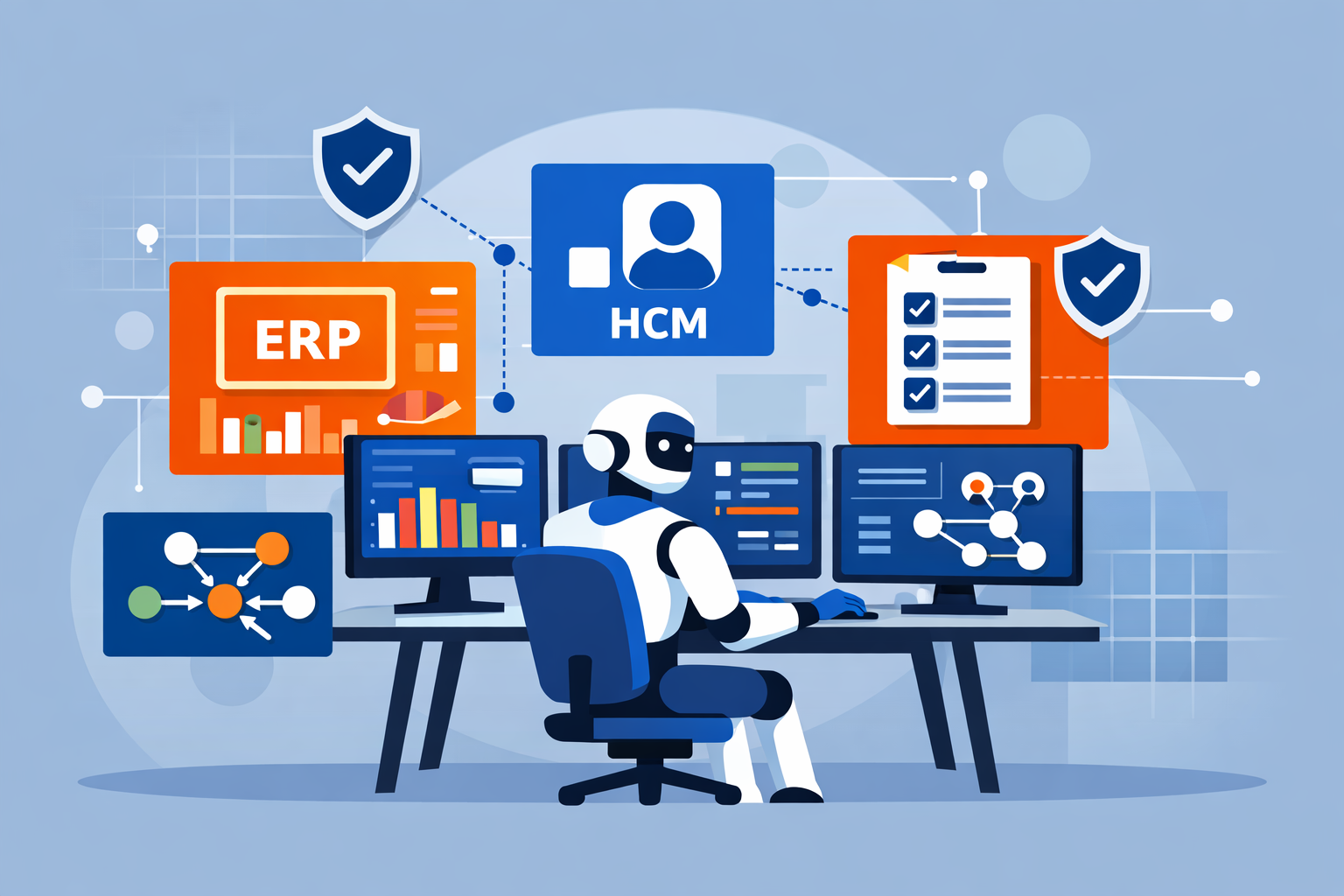
Batch processing is giving way to real-time synchronization across ERP, CRM, HR, and supply chain systems[3], enabling decisions in minutes rather than days. According to McKinsey, enterprises can automate up to 50% of their workflows with AI, but realizing that potential requires data that automated systems can trust and act on consistently.
The practical governance benefit is equally important. A well-implemented semantic layer creates native data lineage - a traceable record of where data originated, how it was transformed, and which automated decisions it informed. This lineage is not merely an audit convenience; it is increasingly a regulatory requirement. The EU AI Act's high-risk system obligations apply from August 2, 2026[4], with penalties for non-compliance reaching 7% of global annual turnover.
For enterprise architects, the priority is selecting automation platforms that natively support metadata management, data provenance, and interoperability with existing data governance frameworks - rather than treating these as post-deployment additions.
Pattern 3: Risk-Aware Automation as a Core Operating Principle
The third - and arguably most differentiating - pattern is embedding governance directly into the automation layer itself, rather than treating it as a separate oversight function applied after deployment.
According to a 2026 Harvard Business Review Analytic Services study commissioned by Appian, 59% of organizations now have AI in production, yet governance frameworks struggle to keep pace with deployment speed[5]. The result in many organizations is a growing blind spot: automation accelerates operational output while compliance documentation is created reactively rather than embedded into each workflow step.
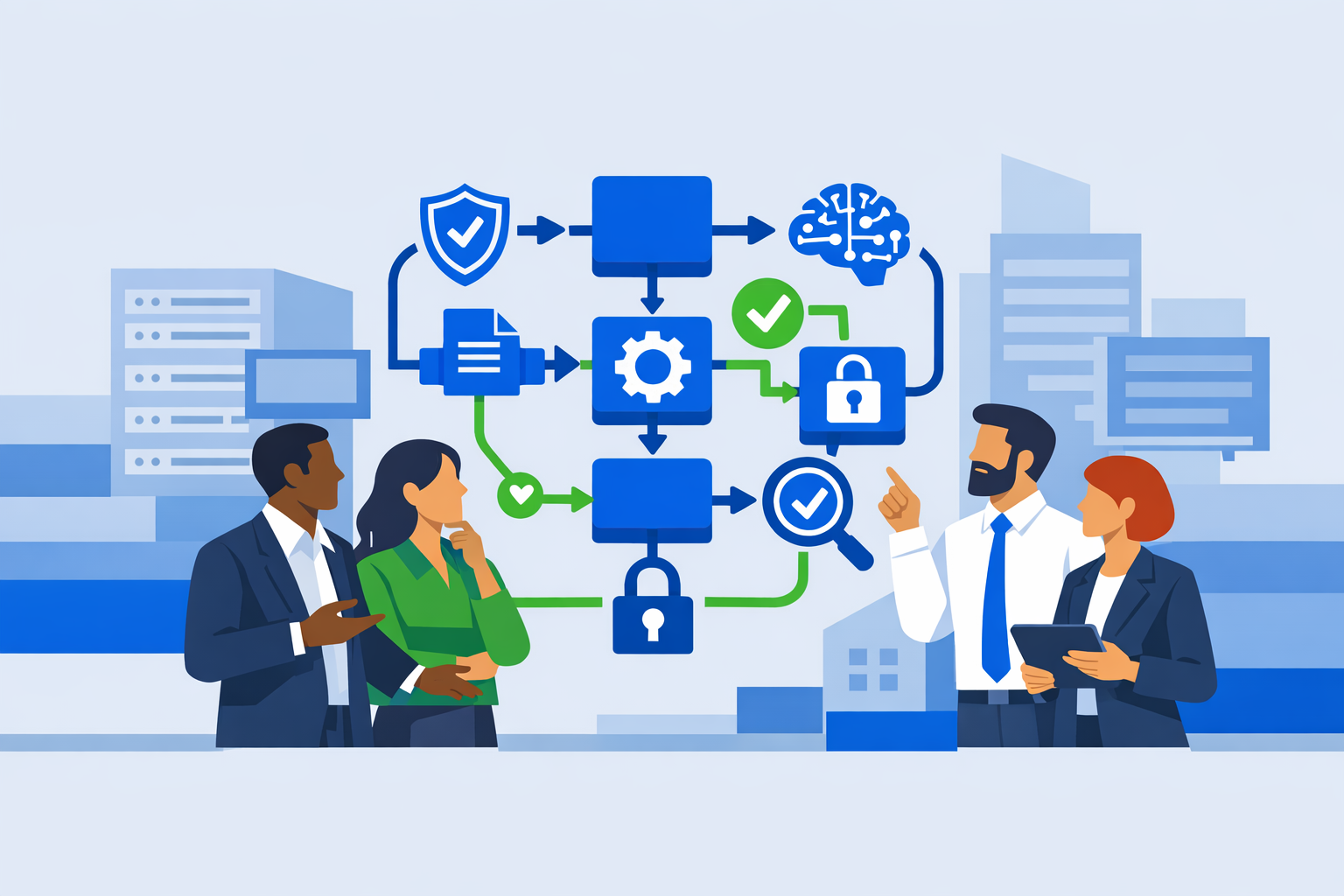
Forward-looking enterprises address this through what can be termed process-centric AI governance: an architectural approach in which agentic AI integrates into existing workflows from the ground up, with all requisite security and governance built in[6], rather than running as an isolated experimental layer. This approach preserves the predictability and auditability that regulated organizations require while enabling AI to operate at enterprise scale.
Practically, this means:
- Human-in-the-loop checkpoints at high-risk decision points (loan approvals, medical claim processing, regulatory filings)
- Policy-as-code rules that enforce organizational and regulatory constraints within each automated workflow in real time
- Immutable audit trails that log every input, reasoning step, tool invocation, and output - queryable by compliance teams and regulators
- Automated drift monitoring to detect when production automations begin behaving differently from their validated baseline
{{component:callout}}
Poor governance after go-live causes 25-40% of automation gains to erode within 18 months[7] due to process drift and inadequate maintenance. Risk-aware automation is not a constraint on efficiency - it is the mechanism that sustains it.
The ROI Calculus: What CIOs Should Measure
One of the persistent obstacles to automation ROI is measurement scope. Organizations focused exclusively on headcount reduction underestimate true ROI by 30-60%[7] compared to those that also track error elimination, compliance improvements, and cycle time gains. Manual processes typically have error rates of 3-5%, while automated workflows reduce errors to under 0.1% - yet the cost of avoided rework rarely appears in standard ROI models.
A more complete measurement framework spans four dimensions:
- Cycle time reduction - the delta between current and automated process completion times
- Error and rework cost elimination - the financial value of errors that no longer occur
- Compliance and audit cost reduction - time and cost saved through automated documentation and audit trail generation
- Operational resilience - reduced risk of process failure, escalation, or regulatory exposure
Use the interactive estimator below to model automation ROI for a specific workflow:
{{widget:roi_estimator}}
Implementation Roadmap: Six Steps to Governance-Ready Automation
{{component:steps}}
The Organizational Dimension: Centers of Excellence
Technology choices alone do not determine automation outcomes. Enterprise automation in 2026 is not a single product or platform - it is an organizational capability[8] spanning IT, operations, data, risk, and leadership.
Leading organizations formalize this reality by establishing cross-functional Centers of Excellence (CoEs) for automation governance. A CoE serves as the internal authority for workflow standards, success metrics, vendor evaluation, and cross-unit knowledge sharing. It prevents the proliferation of fragmented, ungoverned automations that deliver short-term wins but generate long-term technical debt.
The CoE model also addresses a critical talent challenge: rather than deploying automation solely to replace tasks, high-performing organizations upskill staff to design, monitor, and supervise automated processes. 73% of IT leaders credit automation with helping employees save 10-50% of the time previously spent on manual tasks[9] - freeing that capacity for higher-value analytical and strategic work.
Key Takeaways for CIOs and Operations Leaders
- Standardize before scaling. Build reusable, semantically enriched workflow templates across departments rather than deploying point-solution automations.
- Treat semantic integration as infrastructure. A semantic layer and data lineage capability are prerequisites for trusted automated decisioning - not optional enhancements.
- Embed governance; don't bolt it on. Risk-aware automation requires policy-as-code, audit trails, and human-in-the-loop controls built directly into workflow design.
- Measure the full ROI surface. Include error elimination, compliance cost reduction, and operational resilience alongside labor savings.
- Establish a CoE. Sustained automation ROI requires organizational structure, not just technology investment.
Enterprises that treat automation as a strategic, governance-first capability[10] - rather than a tactical efficiency measure - are converting Knowledge 2026 from a conference theme into a measurable performance advantage. For organizations evaluating their automation stack, the priority questions are not which tools automate the most tasks, but which platforms provide the native governance, metadata, and interoperability controls that keep deployments auditable and compliant as scale increases.
Related reading: Enterprises Deploy AI Workflow Agents to Coordinate Across Systems and Capture ROI | Governed AI Becomes Standard in Enterprise Workflow Platforms