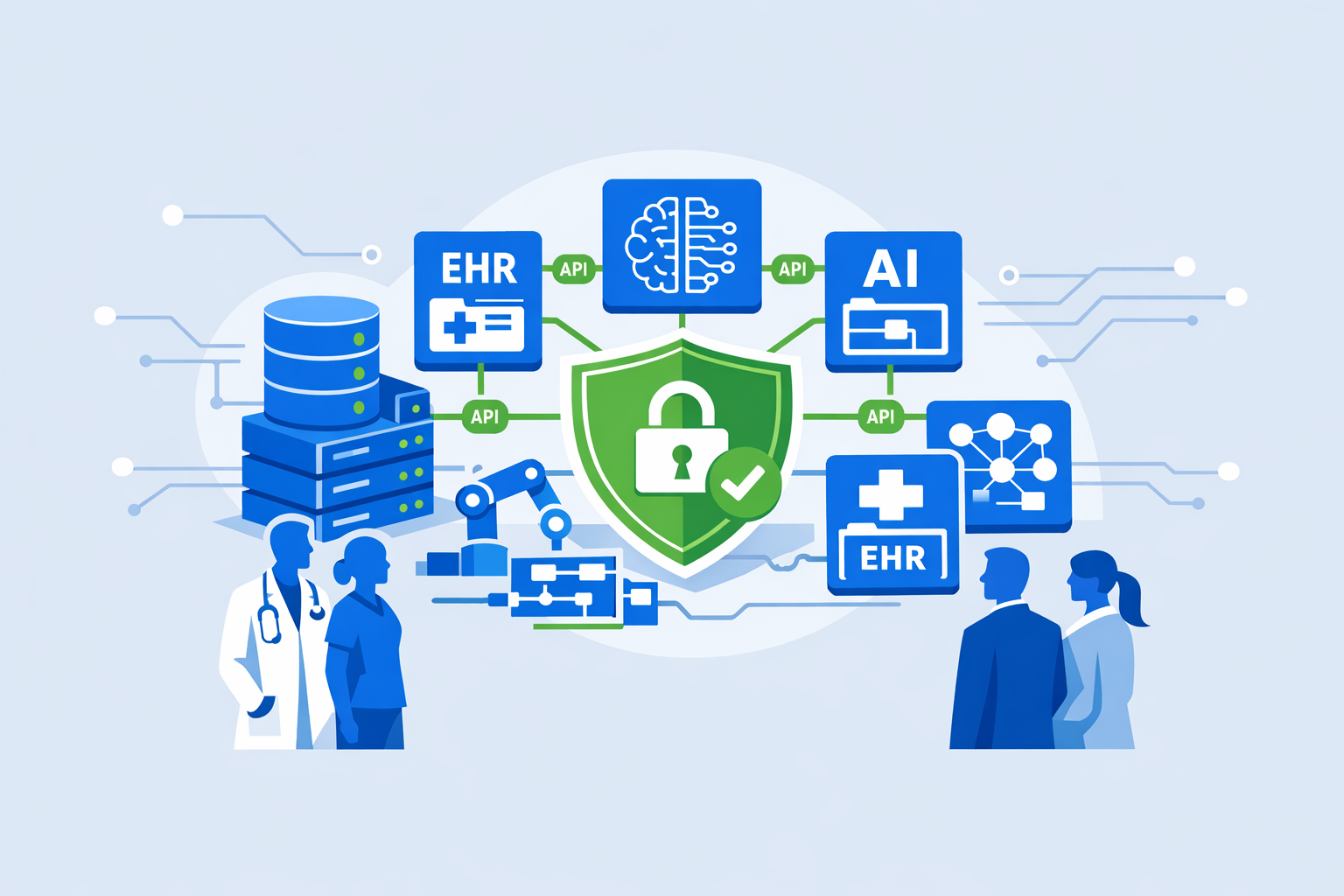
Only 12% of enterprise leaders believe their data is ready for AI, according to Stanford's 2025 AI Index[1]-and in healthcare, where patient safety and regulatory compliance are non-negotiable, that gap carries serious consequences. Yet recent ERP readiness pilots across health networks are producing a clear corrective: organizations that invest in data governance before deploying AI see faster go-live timelines, lower migration risk, and more predictable returns. The message from the field is unambiguous-governance maturity is the precondition for healthcare AI automation, not an afterthought.
Why Governance Maturity Comes First
Healthcare organizations face a compounding challenge: the data ecosystems that need to feed AI models are among the most fragmented in any industry. Legacy electronic health record (EHR) systems often contain siloed patient records that cannot easily interoperate with administrative platforms or supply-chain ERPs. An estimated 80% of medical data is unstructured or unused after it is created, according to healthcare data pipeline analysis[2], leaving the bulk of clinical information unavailable to AI systems without significant preprocessing.
In a parallel challenge covered in our analysis of patient financial experience automation, 62% of healthcare organizations identified data quality and system fragmentation as major barriers to AI adoption, while 42% reported difficulties meeting regulatory and ethical requirements. ERP readiness pilots now surface this same dynamic at enterprise scale: AI models are only as reliable as the data pipelines that supply them.
The central finding from recent pilots is that robust data governance-covering patient identifiers, provenance tracking, and consent management-substantially reduces migration risk and compresses ERP go-live timelines in complex hospital ecosystems. As one multi-year engagement described by First San Francisco Partners illustrates, connecting business metadata to technical lineage[3] "paved the way to defining business and quality rules tied to specific data elements, building trust in the data powering AI models and decision-making."
The ERP Readiness Pilot Findings
Health networks completing readiness assessments in recent quarters have converged on several structural prerequisites:
Harmonized data dictionaries across EHR, administrative, and supply-chain platforms are the foundational requirement. Without shared definitions for patient identifiers, billing codes, and inventory units, AI agents encounter definitional conflicts that produce erroneous outputs-particularly damaging in revenue cycle management, where coding errors translate directly to claim denials and revenue leakage.
Data lineage and provenance documentation are equally critical. Regulators and auditors increasingly require[1] that every AI forecast, alert, or recommendation be traceable-showing which data was used, what logic was applied, and how results were produced. Without this foundation, AI outputs cannot withstand regulatory scrutiny.
Interoperability via standardized APIs is the connective tissue. The U.S. 21st Century Cures Act and CMS rules mandate FHIR-standard APIs for patient data access[2], and by 2025, all certified EHRs must support the latest data standards (USCDI v3) via FHIR API. Organizations that have built their ERP migration strategies around FHIR-compliant data exchange report substantially smoother integration between clinical and operational systems.
Vendors participating in these pilots consistently report that governance maturity correlates with faster ROI and safer AI agent adoption. Early adopters of AI-enabled ERP software already report 30-40% efficiency gains[1], though these results depend heavily on data readiness.
Use Cases: Where Governance Unlocks AI Value
Three operational domains are emerging as the primary beneficiaries of mature governance-enabled automation:
Revenue Cycle Management
Revenue cycle management (RCM) is the highest-priority application. The percentage of providers reporting denial rates above 10% surged from 30% in 2022 to 41% in 2025, according to Experian Health's State of Claims report[4], driven in part by payers deploying AI-powered denial systems that review and reject claims at machine speed.
AI-unified revenue cycle systems[5] can "shift left" on claim error detection-surfacing documentation gaps and coding-evidence mismatches during pre-bill processing, before claims are submitted. This requires AI agents that reason consistently across structured EHR data and unstructured clinical notes, which in turn demands harmonized data models and clean lineage from source to output. Survey data shows 72% of healthcare executives report technology automation and AI as their highest-priority revenue cycle investment for the next 12 months, per Notable Health's 2025 RCM executive survey[6].
Supply Chain Optimization
Data governance is also reshaping supply-chain operations. According to GHX's 2026 healthcare supply chain analysis[7], inaccurate item masters, misaligned contract data, and inconsistent standards slow automation and limit analytics capabilities in supply chain environments. The industry is accelerating efforts to build data ecosystems that synchronize information across providers, suppliers, and technology partners-treating data governance as a C-suite operational mandate rather than a back-office function.
ERP platforms serve as the unifying layer: connecting pharmacy purchasing, inventory management, and procure-to-pay workflows under a single governed data model reduces the fragmentation that undermines AI-driven demand forecasting and inventory optimization.
Clinical Documentation Automation
AI automation of clinical documentation-including ambient listening and AI-generated clinical summaries-depends on the same governance infrastructure. OpenAI's "OpenAI for Healthcare" enterprise stack[8], already adopted by institutions including HCA Healthcare, AdventHealth, and Cedars-Sinai, bundles AI capabilities with business associate agreements (BAAs) for HIPAA alignment. The architecture underscores a broader principle: AI governance is shifting from model selection to data-plane control, with data residency, auditability, and consent models becoming as strategically important as model capability.
The Regulatory Landscape: From Principles to Operational Controls
Regulators are accelerating the shift from high-level AI governance frameworks to mandatory operational requirements. Joint efforts by the FDA and EMA, alongside UN-affiliated frameworks, are establishing unified benchmarks[9] for transparency, human oversight, and lifecycle governance in clinical AI applications. The EU AI Act establishes the world's first comprehensive legal framework categorizing AI systems by risk-with healthcare applications falling predominantly in high-risk tiers subject to the strictest oversight.
In the U.S., interoperability standards such as TEFCA enforce consistent, controlled data flows between providers, researchers, and networks[10], with compliance built into data pipelines rather than applied retroactively.
The practical implication for enterprise IT leaders: secure-by-default configurations, continuous monitoring, and auditable AI decision trails are now procurement-level requirements, not aspirational goals. Partnerships forming between ERP integrators, data governance platforms, and AI vendors reflect this reality-end-to-end compliance capability is becoming a baseline vendor qualification.
A Five-Step Path to ERP Readiness for Healthcare AI
For health system leaders evaluating their current posture, the pilots point to a sequential governance build-out before full AI deployment:
Establish a unified data dictionary - Harmonize patient identifiers, clinical terminologies, and financial codes across EHR, administrative, and supply-chain systems to eliminate definitional conflicts during ERP migration.
Implement data lineage and provenance tracking - Document the origin, transformation, and movement of all data assets, connecting business metadata to technical metadata to create the audit trail regulators and auditors require.
Define consent management and privacy controls - Embed privacy-by-design principles with minimum-necessary data access for AI agents and FHIR-standard API enforcement across EHR and billing integrations.
Conduct structured ERP readiness assessments - Evaluate data quality rules, interoperability coverage, and master data completeness before go-live, including security controls at every stage of ERP adoption.
Deploy continuous monitoring and governance controls - Establish ongoing AI model performance tracking, data quality monitoring, and clear team roles for approving updates and managing deviations post-deployment.
Healthcare organizations progressing through this sequence can expect more predictable deployments, fewer migration-related incidents, and clearer accountability for AI-driven decisions across patient administration, billing, and supply-chain operations.
Key Takeaways for Enterprise IT and Clinical Operations Leaders
- Data governance maturity, not model sophistication, is the primary differentiator in successful healthcare AI deployments. More than half of health IT leaders cite infrastructure and data governance-not the AI tools themselves-as the biggest barriers to AI adoption, per Healthcare IT Today's 2026 predictions survey[10].
- ERP readiness pilots show that harmonized data dictionaries and provenance practices accelerate go-live timelines and reduce migration risk in complex hospital ecosystems.
- Revenue cycle management, supply-chain optimization, and clinical documentation are the highest-ROI early applications, contingent on clean, governed data.
- Regulatory requirements are becoming operational - FHIR mandates, EU AI Act risk classifications, and TEFCA interoperability standards are reshaping vendor procurement criteria.
- Partnerships between ERP integrators, data governance platforms, and AI vendors are producing end-to-end compliant automation architectures that individual point solutions cannot replicate.
Only 30% of AI pilots in healthcare reach production[11], and over one-third of health system leaders admit they lack an AI prioritization process. The organizations closing that gap are doing so through disciplined governance investment-treating data readiness as the strategic enabler of AI, not a technical prerequisite to address later.