Only 5% of enterprise AI pilots ever reach production-a statistic that should alarm any CIO investing in automation. The gap between a working prototype and a maintainable, enterprise-grade workflow has long been the principal barrier to realizing returns on AI investment. Carly AI's newly announced Workflow Automation Builder targets that gap directly, introducing an expanded no-code environment designed to bring AI-powered processes to production scale while embedding the governance controls large organizations require.
The announcement arrives as enterprises navigate a pivotal transition: moving automation from isolated departmental experiments to cross-functional, mission-critical workflows in finance, human resources, and customer operations.
What Carly AI Is Launching
Carly AI-an AI agent platform with integrations spanning CRM, ITSM, ERP, calendaring, and communications systems-has enhanced its Workflow Automation Builder with capabilities aimed at bridging the gap between ease of use and enterprise-grade control.
Key additions include:
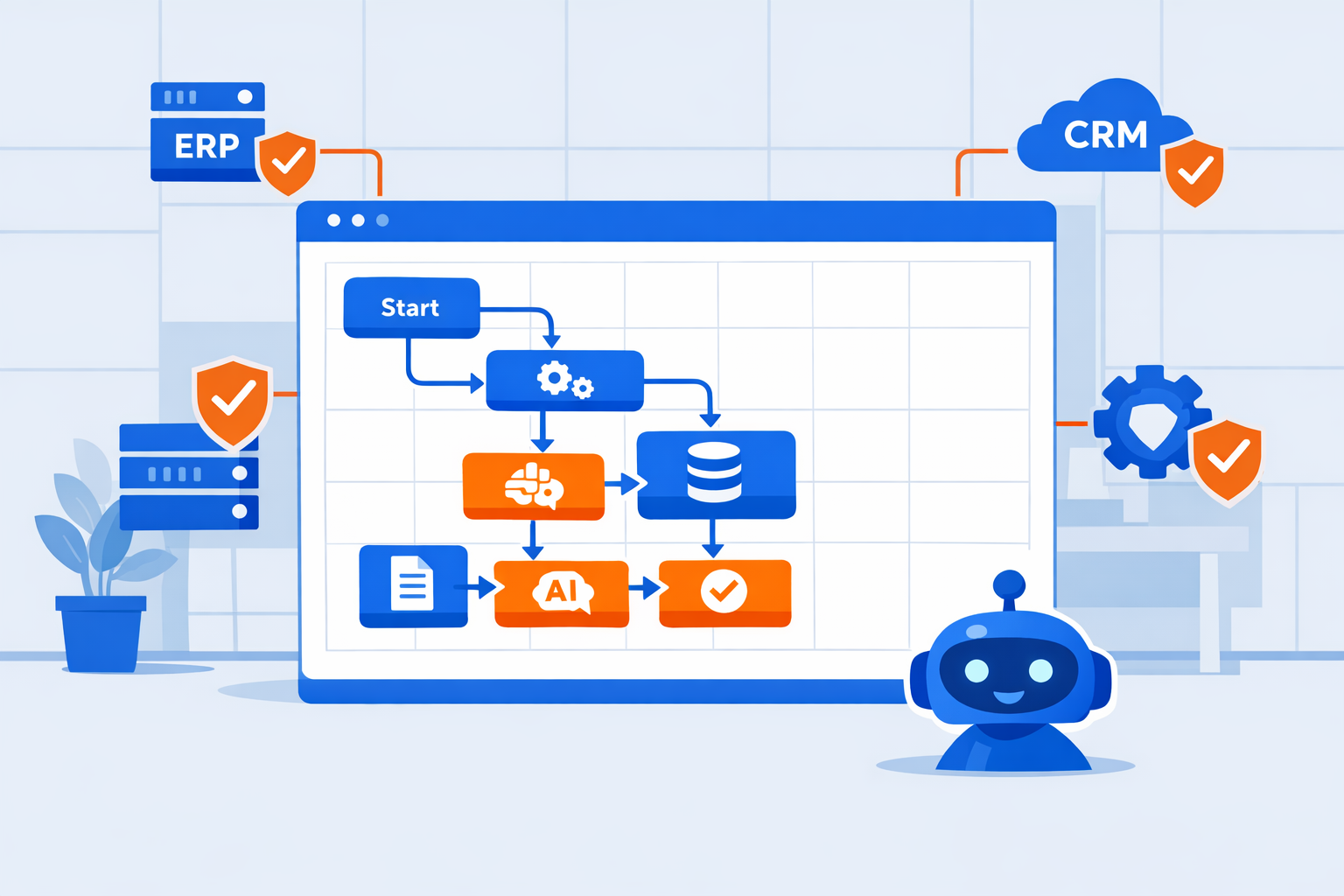
- Expanded no-code AI steps: Pre-built, configurable AI actions that business users can sequence visually without writing code, enabling finance analysts, HR teams, and operations managers to automate complex multi-step processes independently.
- Embedded governance controls: Policy enforcement rules, role-based access controls, and approval workflow gates configured at the builder level-not bolted on after deployment.
- Interoperability with ERP, CRM, and ITSM: Pre-built connectors enable workflows to read from and write to platforms such as Salesforce, HubSpot, ServiceNow, and major ERP systems, reducing reliance on custom middleware.
- Audit trails: Immutable logs of workflow actions and decision points support compliance reporting and post-incident forensics.
- Adaptive agent memory: AI agents retain contextual memory across workflow executions, improving accuracy over time without manual reconfiguration.
The platform's email-native interaction model-allowing agents to be triggered and managed through email or SMS without deploying a separate application-is positioned as a key adoption accelerant for large organizations where change management remains a persistent obstacle.
Why Enterprises Are at an Automation Inflection Point
The Carly AI announcement lands against a backdrop of accelerating enterprise adoption of no-code and AI-powered automation tools.
Gartner predicts that by 2026, 80% of low-code users will come from non-IT departments, up from 60% in 2021-reflecting a structural shift in who builds automation within large organizations. 84% of enterprises have already adopted low-code or no-code platforms specifically to reduce IT backlogs and accelerate application delivery, according to market benchmarks.
The pipeline of prospective adopters is wide. Over 65% of enterprises have adopted some form of citizen development model by 2025, with active programs across finance, operations, and HR departments. At the same time, the no-code AI market is growing rapidly[1], with platforms expanding at 31-38% CAGR and expected to reach approximately $25 billion by 2030.
Yet adoption momentum alone does not deliver operational results. As prior analysis in this publication has documented, enterprises deploying AI workflow agents at scale report that the transition from pilot to production remains the hardest mile-requiring robust integration architecture, governance maturity, and measurable ROI frameworks.
The Citizen Developer Tension: Accessibility vs. Control
The central design challenge for enterprise automation platforms is balancing two competing priorities.
Citizen developers-operational staff, finance leads, and HR managers who build workflows in no-code environments-prioritize speed, simplicity, and low learning curves. Enterprise IT and security teams prioritize auditability, policy enforcement, data residency controls, and integration stability. The table below maps these divergent requirements:
| Consideration | Citizen Developer Priority | Enterprise IT Priority |
|---|---|---|
| Builder Interface | Visual, drag-and-drop, minimal learning curve | Extensible, with SDK access for custom logic |
| Governance | Lightweight approval flows | RBAC, audit logs, embedded policy enforcement |
| Integration Scope | Common SaaS apps (CRM, email, calendar) | ERP, ITSM, data warehouses, legacy systems |
| Deployment Speed | Same-day workflow launch | Staged rollout with testing and change management |
| Compliance | Basic data handling | GDPR, SOC 2, HIPAA, industry-specific mandates |
| ROI Measurement | Time saved on individual tasks | Process cost reduction, error rates, SLA metrics |
Platforms that optimize too far for citizen developer accessibility tend to generate ungoverned automations that create shadow IT risk. Those that over-index on IT control often stall adoption by making the builder too complex for operational teams to use independently.
Carly AI's approach-embedding governance at the builder layer rather than applying it as a separate administrative overlay-represents the design philosophy enterprise-grade automation platforms are converging on. As one industry analysis[2] frames it: "Ungoverned low-code becomes shadow IT. Governed low-code becomes your operational backbone."
Note: Organizations evaluating no-code AI workflow platforms should assess governance capabilities during initial demos-not as a post-procurement checklist item. Role-based access, audit logging, and policy enforcement are significantly harder to retrofit than to configure at the outset.
Measuring ROI Across Finance, HR, and Customer Operations
For senior IT and procurement leaders, the business case for enterprise automation platforms must extend beyond anecdotal efficiency gains. Carly AI's expanded builder targets three functional domains where automation ROI is most defensible:
Finance Operations
Automated workflow candidates include invoice processing, reconciliation, and approval routing. AI-enabled workflows can reduce manual processing costs and error rates measurably. Enterprises running automation in core financial processes report 25-30% productivity gains and up to 60% reductions in manual processing costs from AI workflow automation. The no-code model further reduces the cost of building and iterating on these workflows-citizen developers cost 40-60% less than professional developers for comparable automation tasks.
Human Resources
HR workflows-onboarding, document processing, policy acknowledgment, leave management-involve high repetition and significant cross-system data movement between HRIS, ERP, and communication platforms. No-code AI builders allow HR operations teams to own the automation lifecycle without IT queue dependency. Organizations adopting low-code report 50-70% faster development cycles compared to traditional development methods.
Customer Operations
CRM-integrated automation-lead enrichment, case routing, follow-up sequencing, sentiment-triggered escalations-is where Carly AI's existing integration depth (spanning Salesforce, HubSpot, and major ITSM platforms) provides a direct advantage. Workflows that coordinate across CRM, email, and ITSM reduce handling time and improve SLA adherence without requiring custom API development from engineering teams.
Key Evaluation Criteria for Enterprise Procurement Teams
For IT directors and enterprise architects assessing the Carly AI Workflow Automation Builder-or any comparable platform-the following criteria reflect the requirements of production-grade enterprise deployment:
- Integration depth: Does the platform connect natively to the organization's ERP, CRM, and ITSM systems? Are connectors pre-built, or does integration require custom API development?
- Governance architecture: Are access controls, audit trails, and policy enforcement configured at the workflow builder level or applied externally?
- Deployment flexibility: Does the platform support private cloud, VPC, or on-premise deployment for organizations in regulated industries with data residency requirements?
- AI evaluation tooling: Can workflow administrators test prompt changes and AI decision logic before promoting to production? This has become a hard requirement in enterprise demos[3].
- Scalability model: How do pricing and performance scale as workflow volume increases? Fixed-usage models reduce cost unpredictability at scale.
- Change management support: Does the vendor provide structured onboarding, role-specific training, and certification programs for citizen developer initiatives?
Key consideration: Only 5% of enterprise AI pilots make it to production, according to MIT NANDA's State of AI in Business 2025. The primary bottleneck is the gap between a working prototype and a maintainable, observable production system. Enterprises should evaluate platforms on the features that close that gap-observability, version control, and governance-not just ease of initial build.
Outlook: From Automation Pilots to Production Infrastructure
The broader enterprise automation market is approaching a tipping point. The share of companies running automation in most core processes is projected to rise from 60% in 2024 to 85% by 2029, according to industry analysis-signaling that process automation is transitioning from a competitive differentiator to baseline infrastructure.
For enterprises still managing a patchwork of departmental automation tools, platforms like Carly AI's enhanced builder represent an opportunity to consolidate around a governed, interoperable standard before fragmentation becomes entrenched. As previously covered in this publication, governed AI is becoming the standard in enterprise workflow platforms, driven by evolving compliance requirements and the maturation of enterprise AI oversight frameworks.
The practical implication for CIOs and IT directors is clear: the question is no longer whether to deploy no-code AI workflow automation, but how to do so under a governance model that scales with organizational complexity. Platforms that embed policy controls, ERP/CRM interoperability, and audit trails into the builder experience-rather than treating them as administrative afterthoughts-are positioned to survive the transition from pilot infrastructure to enterprise backbone.
FAQ
What is a no-code workflow automation builder? A no-code workflow automation builder is a visual development environment that allows business users to design, configure, and deploy automated processes without writing code. Users sequence pre-built actions-including AI-powered steps-through a drag-and-drop interface, connecting enterprise systems such as ERP, CRM, and ITSM platforms.
How does Carly AI's platform differ from general-purpose automation tools like Zapier or Make? Carly AI positions its platform for enterprise-scale operations, with embedded governance controls, role-based access, audit logging, and deeper integration with ERP and ITSM systems. General-purpose tools such as Zapier are optimized for simpler, high-volume trigger-action automations and often require additional tooling to meet enterprise compliance and governance requirements.
What governance features should enterprises require in an AI workflow builder? At minimum: role-based access control (RBAC), immutable audit trails, approval workflow gates, policy enforcement rules configurable at the builder level, and support for regulated deployment environments (VPC, on-premise). For regulated industries-financial services, healthcare, public sector-SOC 2, GDPR, and HIPAA compliance certifications are non-negotiable.
How should enterprises measure ROI on no-code automation investments? ROI measurement should span multiple dimensions: cycle time reduction for targeted processes, manual processing cost savings, error and exception rate changes, IT backlog reduction, and-where applicable-headcount redeployment to higher-value tasks. A payback period of 6-12 months is commonly cited as a benchmark for no-code platform investments.
Is citizen development a governance risk? Without a structured governance framework, yes. Ungoverned citizen development can introduce shadow IT, inconsistent data handling, and compliance exposure. Platforms that embed governance at the builder level-rather than relying on post-deployment administrative controls-mitigate this risk while preserving the speed benefits of business-led automation.