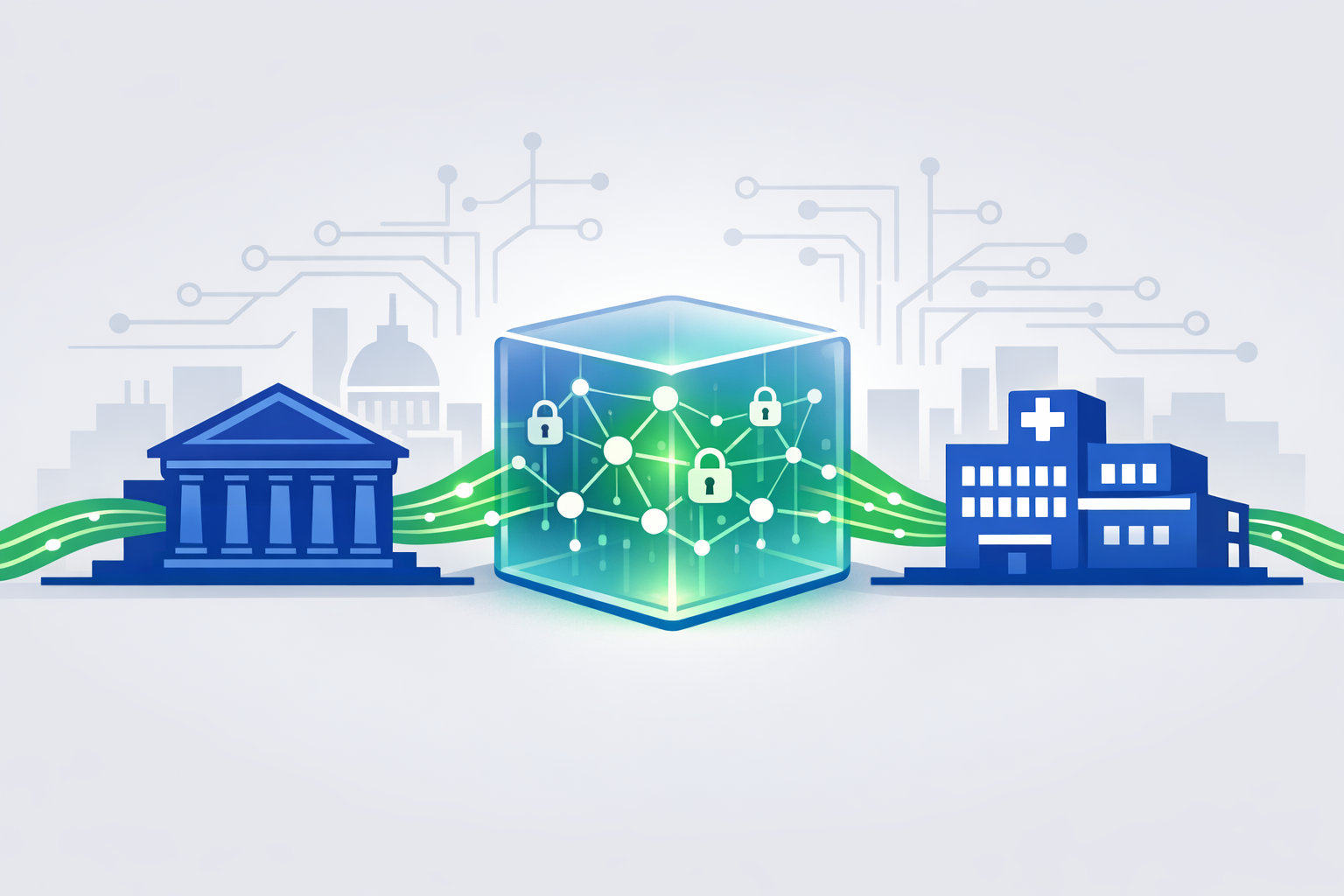
Financial services firms and healthcare systems are deploying data clean rooms-secure environments that enable multi-party analytics without exposing underlying data-as a foundational governance mechanism for compliant AI model development and cross-institutional data collaboration.
Background
Pressure from multiple directions is driving the shift. The EU's enforcement actions under GDPR resulted in cumulative fines exceeding €4.5 billion by the end of 2025, signaling to financial institutions and hospital networks that non-compliant data sharing carries direct financial exposure. Simultaneously, AI deployments in both sectors require richer training datasets than any single organization typically holds, creating structural incentives for cross-party data collaboration.
Healthcare organizations increasingly need to analyze and share data across institutional boundaries while maintaining strict privacy, security, and governance controls. Data clean rooms have emerged as one approach, providing controlled environments where multiple parties can work with data without exposing underlying datasets. Interest in these environments has grown alongside wider concerns about cyber resilience, operational continuity, and regulatory expectations around data protection and incident response.
In financial services, use cases extend to joint fraud detection-for example, two banks collaborating to identify suspicious transaction patterns by securely bringing their data and models into a shared clean room, running agreed-upon analytics, and sharing approved results while maintaining robust data governance and compliance.
Details
The global data clean room market was valued at $3.2 billion in 2025 and is projected to reach $18.6 billion by 2034, representing a compound annual growth rate (CAGR) of 21.7%. The Healthcare and Life Sciences segment is the second-fastest-growing application vertical, projected to grow at a CAGR of 25.3% through 2034, driven by demand for privacy-preserving patient data collaboration across payers, providers, pharmaceutical companies, and contract research organizations. The BFSI segment captures approximately 12.4% of the market in 2025, with major banks deploying clean rooms for fraud prevention data sharing, marketing personalization, and ESG reporting data aggregation.
A regulatory milestone is accelerating healthcare adoption. In 2025, the FDA's updated Real-World Evidence framework explicitly recognized privacy-preserving computation techniques, including clean rooms, as acceptable methods for generating real-world evidence in regulatory submissions-a development expected to drive significant incremental investment in healthcare clean room infrastructure through 2026 and beyond.
Payer-provider data collaboration via clean rooms enables joint analyses of treatment efficacy, population health outcomes, and cost-of-care patterns that traditional data-sharing agreements cannot support due to HIPAA constraints and competitive sensitivities. Real-world evidence generation-combining claims data from payers with clinical data from providers and patient-reported outcomes-is now routinely structured around clean room architectures by leading pharmaceutical companies including Pfizer, Roche, and Novartis.
The technical architecture centers on preventing raw data exposure entirely. Rather than exchanging full datasets, participating organizations contribute data in accordance with their internal governance rules and applicable privacy and security requirements. Access is typically limited to approved queries and predefined analytical methods, with outputs restricted to aggregated results, statistical summaries, or other privacy-preserving derivatives. Identifiers, proprietary elements, and raw records remain inaccessible to other participants. Organizations can collaborate within the clean room using advanced privacy-enhancing features such as protected governance and audit, verifiable trust, differential privacy, and controlled access.
Lee Kim, HIMSS Senior Principal for Cybersecurity and Privacy, described the clean room's value proposition for healthcare innovation as enabling multiple entities to collaborate on research or technology initiatives without compromising governance controls. "It preserves each party's data ownership and operates in accordance with applicable privacy, security and data protection requirements," she said. Instead of viewing raw data, entities "can see aggregated outputs, statistical results, the results of approved queries or privacy-preserving derivative information."
Governance experts caution, however, that compliance is not automatic. "Data clean rooms do not magically make your data collaboration fully compliant," one privacy expert noted. "Clean rooms are capable of making a data collaboration fully compliant if deployed properly, but this will depend heavily on many factors-the specific use case, the data involved, the privacy protections applied and the contract terms that are negotiated."
While data clean rooms offer potential benefits, their effectiveness depends on deliberate design and oversight. Privacy and security protections are not inherent simply because a clean room exists-they depend on how constraints are defined, implemented, and monitored over time. Poorly configured environments may fail to limit data use or may introduce new risks rather than mitigating existing ones. The FTC notes that granting more entities access to a data clean room can have the unintended consequence of expanding the perimeter that requires defense. Organizations hosting a clean room must be aware of their partners' overall security practices, data governance policies, and storage and permission configurations. A single partner with lax policies-such as not requiring multifactor authentication-could be sufficient to expose the clean room to an attack.
On the vendor side, hyperscaler cloud platforms-Amazon Web Services, Google Cloud, Microsoft Azure, and Snowflake-have significantly lowered the cost and complexity of clean room deployment by offering native, managed services that eliminate the need for enterprises to build cryptographic infrastructure from scratch. The on-premises deployment segment retained a meaningful 28.8% share in 2025, driven primarily by highly regulated industries-including large financial institutions and certain healthcare organizations-that face strict data residency, sovereignty, or classification requirements precluding use of public cloud environments.
Outlook
Enterprises that have adopted clean rooms report an average 41% reduction in privacy incident response costs and a 28% reduction in data governance labor overhead. The alignment of clean room architectures with privacy-by-design principles articulated in GDPR Article 25, the CPRA's risk assessment requirements, and emerging EU AI Act obligations positions clean rooms as a strategic compliance investment rather than a discretionary technology spend. As AI model development increasingly requires multi-institutional datasets, demand for auditable, interoperable clean room infrastructure across banking and hospital systems is expected to accelerate into 2026.